Don’t Slip Up! Best Concrete Floor Sealing Options Explained
Why Concrete Floor Sealing Matters More Than You Think
Concrete floor sealing options fall into five main categories that protect your floors from damage while enhancing their appearance:
- Penetrating sealers – Invisible protection that soaks deep into concrete pores
- Acrylic sealers – Budget-friendly surface coatings with decent gloss
- Epoxy systems – Heavy-duty but prone to UV yellowing outdoors
- Polyurethane coatings – Flexible and scratch-resistant
- Polyaspartic systems – Next-generation technology that cures in one day
Your concrete floors take a beating every day. Without proper sealing, they absorb oil stains, crack from freeze-thaw cycles, and develop that dusty surface that never looks clean.
The right sealer transforms concrete from a maintenance headache into a durable, attractive surface that lasts decades. But choose the wrong one and you could waste thousands of dollars and be re-doing the job in just a few years.
The stakes are higher than most homeowners realize. Unsealed basements can allow radon gas infiltration, while garage floors without proper protection show permanent tire marks and oil stains within months.
As Hayley Shahbazi, Galaxy Concrete Coatings Manager, I’ve helped hundreds of homeowners sort through concrete floor sealing options to find the perfect solution. My experience with advanced polyaspartic systems has shown why picking the right technology makes the difference between a floor that disappoints and one that performs beautifully for decades.
Simple guide to concrete floor sealing options:
- concrete floor installation process
- concrete floor repair services
- industrial epoxy flooring solutions
Why Sealing Matters—Strength, Safety & Style
Picture this: water slowly seeping into your concrete floor, carrying dissolved salts and chemicals that eat away at the structure from the inside out. This is concrete’s biggest enemy, and it’s happening right under your feet if your floors aren’t properly sealed.
When winter hits and temperatures drop, that trapped moisture becomes a ticking time bomb. It expands as it freezes, creating tiny cracks that grow bigger with each freeze-thaw cycle.
In Denver’s harsh freeze-thaw environment, unsealed driveways develop surface spalling—that flaking, chipping damage—within just 2-3 years. Meanwhile, down in Phoenix’s scorching heat and intense UV exposure, concrete surfaces turn chalky and dusty, creating a maintenance nightmare that never ends.
The right concrete floor sealing options act like a shield, blocking water intrusion while providing the abrasion resistance your floors need to handle daily traffic. But the benefits go way beyond just preventing cracks.
Here’s something most homeowners don’t know: unsealed concrete can actually affect your family’s health. Concrete naturally contains trace amounts of uranium that releases radon gas—the second leading cause of lung cancer after smoking. Proper sealing creates a crucial barrier that significantly reduces radon infiltration through basement floors and foundation walls.
The aesthetic change is equally impressive. Sealed concrete brings out rich color depth, provides that consistent sheen that makes spaces look polished, and eliminates the perpetually dusty appearance that makes even clean floors look dirty. Our advanced polyaspartic systems can transform a dull gray slab into a showroom-quality surface that actually reflects light and brightens your entire space.
According to scientific research on VOC impact, choosing the right sealer also protects your indoor air quality—something we take seriously in every installation.
Hidden Costs of Leaving Concrete Bare
Spalling is expensive. We regularly see garage floors where hot tire pickup has created permanent black marks that require diamond grinding to remove. This costly surface damage could have been completely prevented with proper sealing from the start.
Then there’s the dusting problem. Unsealed concrete continuously sheds fine particles that settle on everything—your stored items, vehicles, and even your HVAC system. This isn’t just unsightly; it can damage sensitive equipment and create respiratory irritation for your family.
The maintenance costs add up fast. Unsealed concrete demands frequent deep cleaning, periodic repairs, and eventual replacement decades sooner than properly sealed surfaces. When you factor in labor and materials for these recurring fixes, investing in quality sealing pays for itself many times over.
Environmental & Health Factors (VOCs)
Not all sealers are created equal when it comes to indoor air quality. Volatile Organic Compounds (VOCs) in some concrete sealers can impact the air you breathe, especially in enclosed spaces like basements and garages.
Water-based acrylic sealers typically contain less than 50 g/L VOCs, making them nearly odorless and environmentally friendly for indoor use. Solvent-based products may exceed 400 g/L but offer superior penetration and durability in challenging conditions.
Our polyaspartic systems strike the perfect balance—low VOC formulations that cure rapidly, minimizing your exposure time while delivering stellar performance. We always recommend proper ventilation and respiratory protection during any sealer application, regardless of VOC content, because your family’s safety comes first.
Exploring Concrete Floor Sealing Options
When you’re staring at that dull, dusty slab in your garage, it’s easy to feel overwhelmed by the many concrete floor sealing options out there. Think of sealers as belonging to two broad families:
- Penetrating sealers that soak into the slab and block moisture from within.
- Topical sealers that form a protective film on the surface.
Each approach has its place, and the differences really come down to appearance, lifespan, and how much abuse the floor sees.
| Sealer Type | Lifespan | Cost/Sq Ft | Gloss Level | Best Use |
|---|---|---|---|---|
| Penetrating | 5–10 yrs | $0.50–1.50 | Natural/Matte | Driveways, patios |
| Acrylic | 2–3 yrs | $0.15–0.75 | Low–High | Light traffic |
| Epoxy | 5–10 yrs | $2.00–4.00 | High | Indoor heavy use |
| Polyurethane | 4–8 yrs | $1.50–3.00 | Satin–Gloss | Moderate traffic |
| Polyaspartic | 25+ yrs | $3.00–7.00 | High | All applications |
Penetrating Sealers – Invisible Shield
Silicate densifiers react with lime in concrete to create calcium-silicate-hydrate, tightening pores and adding strength. Silane or siloxane treatments repel water while letting vapor escape, making them ideal for freeze-thaw or salt exposure. They won’t change color, but they also don’t add stain resistance or gloss.
Acrylic Sealers – Fast & Affordable Sheen
Water-based acrylics are almost odor-free and ultra-budget friendly. They deepen color and add optional gloss, but need re-application every few years and can’t handle hot-tire pickup.
Epoxy Systems – Heavy-Duty Indoors
Two-part epoxies create hard, chemical-resistant surfaces perfect for workshops and manufacturing spaces. However, UV light turns them yellow and chalky, so they’re best kept inside. Installation is slow, temperature sensitive, and the finish becomes brittle over time.
Polyurethane – Flexible Traffic Fighter
Polyurethane topcoats stay flexible, shrug off scratches, and resist UV. They’re a solid mid-range choice when you need good durability without the time constraints of epoxy.
Polyaspartic – Next-Gen Galaxy Choice
Polyaspartic technology combines the toughness of epoxy with the UV stability of polyurethane and cures in a single day—even in cold weather. Galaxy’s polyaspartic coatings deliver lifetime warranties, resist hot-tire pickup, and outperform every other sealer type.
Learn more about polyaspartic advantages to see why we’re a leading installer of advanced polyaspartic systems.
Choosing the Right Sealer for Your Space & Finish
Finding the perfect concrete floor sealing options for your space requires understanding how different environments affect sealer performance. Your garage faces completely different challenges than your basement, and what works beautifully indoors might fail miserably on an outdoor patio.
Traffic patterns tell the whole story. Light foot traffic areas like decorative interior floors can handle budget-friendly acrylics, while heavy vehicular traffic demands the stellar durability of polyaspartic systems. Standard acrylics will show permanent black tire marks within weeks in a busy garage, but they might last years in a basement workshop.
Environmental factors orbit around your decision just as importantly. Freeze-thaw cycles in Colorado winters, scorching UV exposure in Arizona summers, chemical spills in workshops, and moisture levels in basements all influence which sealing technology will launch your floors to success.
The secret is matching sealer chemistry to your specific application. Get this right, and your floors will perform beautifully for decades. Get it wrong, and you’ll be starting over in just a few years.
More information about concrete floor coverings can help you explore additional options for enhancing your concrete surfaces.
High-Wear Areas—Garage & Workshop
Garages are the final frontier for concrete sealers—a challenging environment that eliminates many options before you even start. Hot tire pickup occurs when heated tires from daily driving soften certain sealers, leaving those dreaded permanent black marks that no amount of scrubbing will remove.
Oil stains present another mission-critical challenge. Standard sealers allow automotive fluids to penetrate deep into the concrete, creating permanent discoloration that ruins your floor’s appearance.
Our polyaspartic topcoat systems solve both problems with space-age chemistry. The advanced formulation resists hot tire pickup even from motorcycles and high-performance vehicles that generate extreme heat. Oil spills, brake fluid, and transmission fluid bead up on the surface for easy cleanup rather than penetrating into the concrete.
Moisture-Prone Zones—Basements & Laundry
Basement floors require special consideration that goes beyond basic protection. Moisture control and radon mitigation aren’t just nice-to-have features—they’re essential for creating healthy living spaces.
Radon gas infiltration through basement floors poses serious health risks that many homeowners don’t realize. This invisible threat makes proper sealing a health necessity, not just an aesthetic choice. The right sealing system creates an effective barrier that reduces radon levels while controlling moisture movement.
Our approach combines penetrating sealer followed by polyaspartic topcoat for comprehensive protection. The penetrating sealer blocks moisture and radon at the source, while the polyaspartic topcoat provides a durable, easy-to-clean surface.
Outdoor Exposure—Patios, Driveways, Pool Decks
UV radiation is concrete sealing’s kryptonite—it degrades many systems, causing yellowing, chalking, and complete loss of protective properties. Standard epoxy systems fail rapidly in outdoor applications, while even high-quality acrylics require frequent reapplication to maintain protection under intense sunlight.
Freeze-thaw cycles and deicing salts create additional stress that can destroy inadequate sealers. Water penetrates micro-cracks, freezes, expands, and creates larger cracks in an endless cycle of damage.
For these challenging outdoor applications, penetrating silane/siloxane sealers excel by allowing moisture vapor to escape while blocking liquid intrusion. They won’t change your concrete’s appearance, but they provide invisible protection that lasts for years without maintenance.
More information about concrete driveway sealer options can help you choose the best protection for your specific outdoor application.
Design-Forward Interior Floors
Interior concrete floors offer the greatest design flexibility since UV stability isn’t required—you can focus purely on creating stunning visual effects. High-gloss systems can create dramatic reflective surfaces that brighten spaces and showcase decorative elements.
Color improvement varies dramatically between sealer types and can completely transform your space. Penetrating sealers provide minimal color change, maintaining that natural concrete look. Topical systems can dramatically deepen and enrich concrete tones.
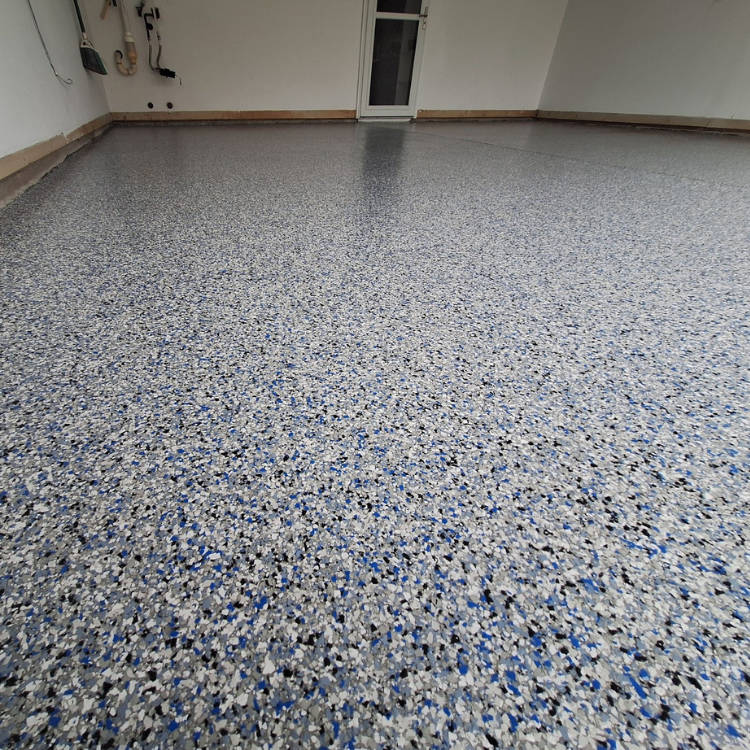
Decorative flakes add texture, color variation, and slip resistance to topical sealing systems. Our polyaspartic flake systems offer unlimited color combinations and can incorporate subtle accents for truly custom appearances that are out of this world.
Prep, Test & Apply Like a Pro
Proper prep is mission-critical—skip it, and even the best sealer will fail. Moisture, contamination, or the wrong surface profile are the three main saboteurs of any coating project.
Moisture Check
Use an ASTM F1869 calcium-chloride test. Readings must be below 4 lb/1,000 ft²/24 hr before applying topical sealers. Higher numbers call for either a breathable penetrating product or professional moisture mitigation.
Is the Floor Already Sealed?
The water-bead test keeps diagnostics simple: drop water on the slab. If it beads for 60 seconds, a prior sealer is present and may need to be stripped or abraded so the new coating can bond.
Surface Prep Checklist
- Deep clean with degreasers and rinse thoroughly.
- Diamond grind or shot-blast to the required Concrete Surface Profile (CSP 1–2 for most residential floors).
- Repair cracks and spalls so sealer doesn’t pool.
Application Playbook
- Plan for temperatures above 50 °F and humidity below 85 %.
- Apply two thin coats instead of one thick one—better penetration, fewer bubbles.
- Use lint-free rollers or an airless sprayer with back-rolling for uniform coverage.
- Respect cure times: acrylics allow foot traffic in 4–6 hours, epoxies in 24–48, and Galaxy’s polyaspartic floors the same day.
ASTM F1869 testing details spell out the exact procedure if you want to dive into the science.
Prep well, and your chosen sealer—especially our polyaspartic system—will deliver out-of-this-world performance for decades.
Maintenance, Resealing & Cost Essentials
Keeping your sealed concrete floors looking stellar doesn’t require rocket science—just the right approach. Proper maintenance extends sealer life and keeps your floors performing at their peak, whether you’ve chosen basic acrylics or our advanced polyaspartic systems.
The secret to long-lasting sealed floors starts with your cleaning routine. Neutral-pH soaps are your best friend here. They clean effectively without attacking the sealer chemistry that protects your concrete. Think of harsh cleaners as kryptonite for your floor’s protective shield—acids and strong alkaline products can break down sealer bonds and leave your concrete vulnerable.
Reseal signals are like warning lights on your dashboard—ignore them at your own risk. When water starts absorbing where it used to bead up, you’re seeing the first sign that your sealer’s protective barrier is weakening. Visible wear patterns in high-traffic areas and loss of gloss are other clear indicators that it’s time to take action.
More information about concrete floor installation process can help you understand what to expect during professional sealing applications.
How Often to Reseal & Why
Wear patterns tell the story of your floor’s life. They develop first in high-traffic zones like doorways, vehicle paths, and work areas. These spots are like the stress points on a spacecraft—they take the most punishment and need the most attention.
Indoor floors typically enjoy a much longer service life than their outdoor counterparts. While your garage floor coating might last 15-20 years, that pool deck is battling UV exposure every single day. Pool decks and patios often need attention every 3-5 years, depending on the sealer type.
Traffic level directly impacts how long your sealer will perform. A rarely-used basement floor might maintain protection for years beyond manufacturer recommendations, while a busy workshop floor experiences accelerated wear from constant foot traffic and equipment movement.
Budgeting—DIY vs Professional
Material costs represent only a small fraction of total sealing expenses—typically 20-30% of the project cost. Professional installation adds $1.50-3.00 per square foot in labor, but that investment includes proper surface preparation, application expertise, and warranty protection.
DIY sealing might seem like a money-saving mission, but it often turns into a costly space disaster. Poor surface preparation, incorrect mixing ratios, or improper application techniques can result in complete sealer failure within months.
Professional warranties provide valuable protection that DIY projects can’t match. Our lifetime warranty on polyaspartic systems eliminates the risk of costly resealing projects and gives you peace of mind that your investment is protected.
Avoiding Common Sealing Mistakes
Thick coats seem like they’d provide better protection—more is better, right? Wrong. Thick applications often cure improperly, developing adhesion problems and uneven appearance. Multiple thin coats penetrate better and create stronger, longer-lasting bonds with the concrete substrate.
Poor ventilation during application creates a cascade of problems. Extended cure times, surface defects, and improper chemical reactions can all result from inadequate air movement. This is especially critical for solvent-based sealers in enclosed spaces like basements and garages.
Incompatible sealer layers are like mixing rocket fuels—the results can be explosive (and expensive). Applying new sealers over existing coatings without verifying compatibility often leads to adhesion failures, bubbling, and uneven appearance.
The bottom line? Professional application eliminates these costly mistakes and ensures your concrete floor sealing options perform as intended. With Galaxy’s advanced polyaspartic technology and expert installation, you get stellar results that last for decades, not just a few years.
Frequently Asked Questions about Concrete Floor Sealing Options
Homeowners often feel overwhelmed by the variety of concrete floor sealing options available. These common questions help clarify the most important considerations when choosing the right protection for your floors.
What is the safest low-VOC sealer for indoor use?
Water-based acrylic sealers contain the lowest VOC levels—typically under 50 grams per liter—making them nearly odorless and safe for basements, workshops, and other enclosed spaces. You won’t need extensive ventilation or worry about lingering chemical smells with these environmentally friendly options.
However, while acrylics offer safety advantages, they require frequent reapplication and provide limited durability. Our polyaspartic systems combine low-VOC formulations with superior performance, giving you the best of both worlds—safety and longevity.
For sensitive environments like home offices or areas where children play, look for sealers that meet Green Building standards. These certified products ensure optimal indoor air quality while still protecting your concrete investment.
Can I apply a new sealer over an old one without stripping?
The compatibility between your existing sealer and the new product determines whether you can skip the stripping process. Applying incompatible sealers creates a recipe for disaster—bubbling, peeling, and adhesion failures that force you to start completely over.
Different sealer chemistries don’t always play well together. Solvent-based products over water-based sealers, or acrylics over penetrating treatments, often result in expensive failures that require professional correction.
The simple water-bead test helps identify whether your floor is already sealed, but determining the exact sealer type may require professional testing. When in doubt, light surface abrading or complete stripping ensures your new sealer bonds properly and performs as expected.
Our Galaxy technicians can quickly assess your existing floor condition and recommend the most cost-effective approach—whether that’s compatible resealing or proper surface preparation for optimal results.
How do I add non-slip texture without dulling the gloss?
Adding slip resistance while maintaining that showroom shine requires the right technique and materials. Concrete floor sealing options like our polyaspartic systems allow you to broadcast aluminum oxide or silica sand into the final coat while it’s still wet, creating texture without significantly reducing gloss levels.
The key is using the right amount of aggregate—too little provides insufficient grip, while too much creates a sandpaper-like surface that’s difficult to clean. Professional application ensures the perfect balance between safety and appearance.
Textured application techniques using specialized rollers can also create slip-resistant surfaces while preserving much of the original gloss. These methods work particularly well for pool decks and outdoor patios where safety is paramount but you don’t want to sacrifice visual appeal.
Our polyaspartic coatings maintain their stellar performance even with anti-slip additives, giving you a surface that’s both beautiful and safe for years to come.
Conclusion
Navigating the vast universe of concrete floor sealing options doesn’t have to feel like rocket science. Whether you choose penetrating sealers for invisible protection, acrylics for budget-friendly improvement, or our advanced polyaspartic systems for stellar performance, the right choice transforms your concrete from ordinary to extraordinary.
What sets our polyaspartic technology apart in this cosmic landscape of options? One-day installation means you’re not orbiting around lengthy downtime. Lifetime warranties provide peace of mind that’s truly astronomical. And performance that outshines every other sealing option in the galaxy—from hot tire resistance to UV stability to chemical protection that’s out of this world.
The numbers don’t lie: while basic sealers might save money upfront, they’ll have you re-entering the sealing atmosphere every few years. Our polyaspartic systems launch your floors into decades of maintenance-free performance, making them the smartest investment in the concrete protection universe.
Every day we see customers who wished they’d chosen professional-grade protection from the start. Don’t let your floors become a black hole of endless maintenance and premature replacement. Whether you’re protecting a garage in Denver’s freeze-thaw cycles or sealing a showroom in Phoenix’s intense UV bombardment, our advanced coatings deliver protection that’s literally stellar.
Find more about polyaspartic vs epoxy floor coatings and see why our technology orbits far beyond traditional sealing options in every measurable way.
Ready to launch your concrete floors into the stratosphere of protection and beauty? Our team of coating specialists is standing by to help you steer the galaxy of sealing choices and land on the perfect solution for your space. With customer satisfaction ratings that shine brighter than distant stars and reviews that are genuinely out of this world, Galaxy Concrete Coatings delivers results that will make your floors the center of your personal solar system.
Galaxy Concrete Coatings Service Areas:
- Denver, Colorado — Service [Page](https://galaxyconcretecoatings.com/colorado/denver/)
- Phoenix, Arizona — Service [Page](https://galaxyconcretecoatings.com/arizona/phoenix/)
- Tucson, Arizona — Service [Page](https://galaxyconcretecoatings.com/arizona/tucson/)
- Cincinnati, Ohio — Service [Page](https://galaxyconcretecoatings.com/ohio/cincinnati/)
- Indianapolis, Indiana — Service [Page](https://galaxyconcretecoatings.com/indiana/indianapolis/)