

Flooring the Competition with Commercial Kitchen Coatings
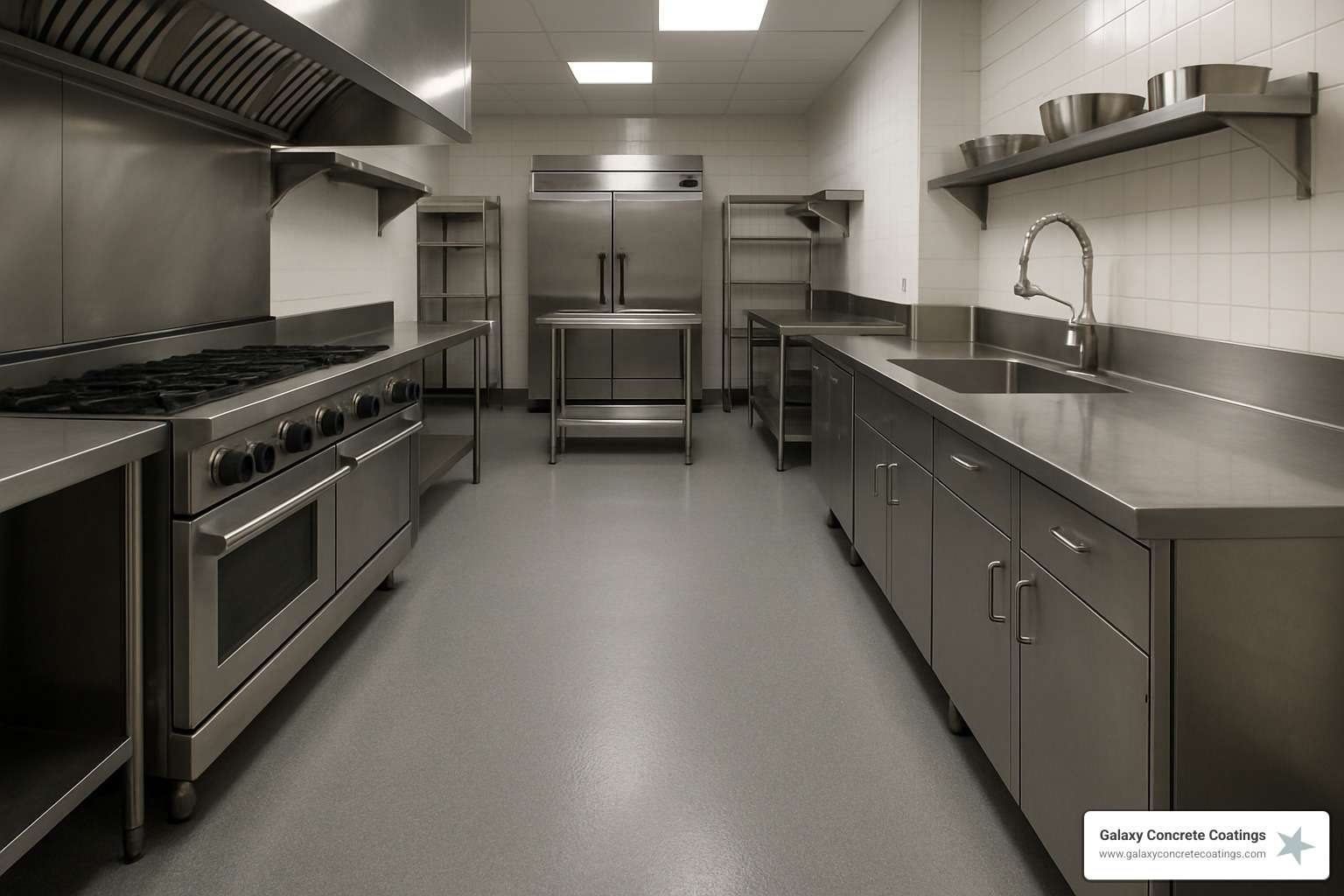
The Foundation of Food Safety and Operational Excellence
Commercial kitchen floor coatings are specialized surface treatments designed to protect concrete floors in food service environments. They provide essential safety, hygiene, and durability features required in demanding culinary settings.
Top Commercial Kitchen Floor Coating Options:
- Polyaspartic Coatings – Fastest cure time (24 hours), excellent durability, UV stable
- Epoxy Systems – Good chemical resistance, economical, longer cure time (3-7 days)
- Urethane Cement – Superior thermal shock resistance, ideal for hot cooking areas
- Hybrid Systems – Combine benefits of multiple coating types for specialized needs
In a commercial kitchen, your flooring faces a daily assault of dropped utensils, food spills, harsh cleaning chemicals, and extreme temperature fluctuations. Standard concrete or tile with grout lines simply can’t withstand these challenges without deteriorating rapidly.
A proper commercial kitchen floor coating isn’t just about durability. It’s about creating a seamless, non-porous surface that prevents bacterial growth and meets strict USDA and FDA regulations. It’s about providing slip resistance to protect your staff from dangerous falls. And it’s about minimizing maintenance headaches and downtime in your busy operation.
I’m Hayley Shahbazi, Galaxy Concrete Coatings Manager and concrete coating specialist with extensive experience implementing commercial kitchen floor coatings that withstand the harshest food service environments while meeting safety and regulatory requirements.
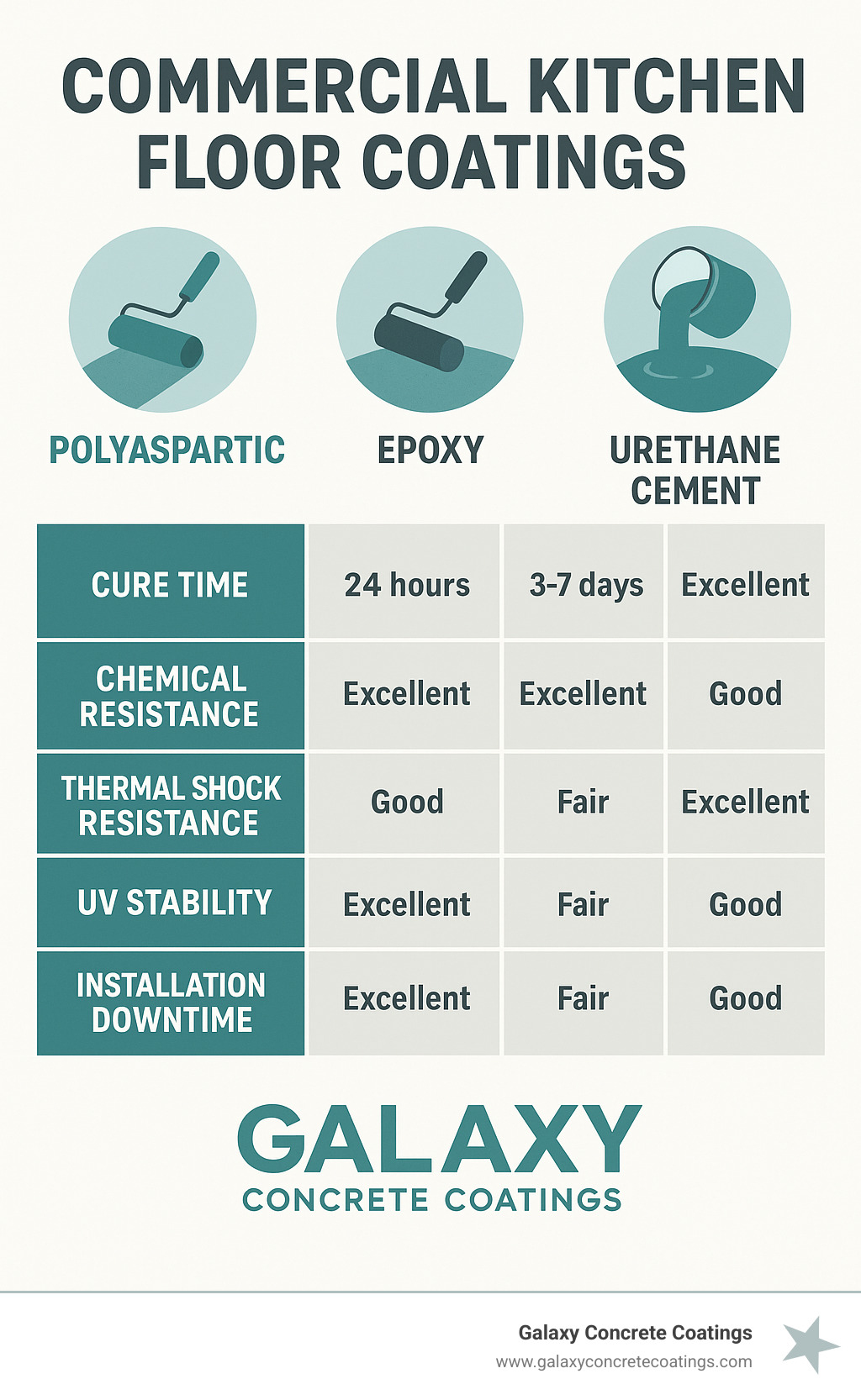
Quick look at commercial kitchen floor coatings:
The Hidden Hero Beneath Your Feet
In the high-pressure world of food service, your floor is the unsung hero taking a constant beating. As one restaurant owner told us after installing our polyaspartic coating: “We’re running 17 hours a day, 6 days a week with no signs of wear. It’s standing up to hot oil, liquids, and industrial cleaners like nothing we’ve had before.”
Commercial kitchens are battlegrounds where thermal shock is a daily occurrence. When a pot of boiling water spills onto a 70°F floor, that sudden temperature change (thermal shock) can crack and deteriorate standard concrete or epoxy coatings. Our polyaspartic coatings can withstand temperatures up to 350°F without damage—a critical feature when your kitchen is constantly juggling hot and cold.
Navigating Commercial Kitchen Floor Coatings 101
Let’s face it – your commercial kitchen floor takes a beating that would make most surfaces surrender within months. When you’re exploring commercial kitchen floor coatings, you need to understand what separates the stellar performers from those that’ll leave you with headaches and repair bills.
Think about what happens in your kitchen daily. That pot of boiling pasta water that occasionally splashes on the floor? Standard epoxies can literally “boil off” under that kind of thermal shock. Our polyaspartic coatings stay cool under pressure, remaining stable even when temperatures fluctuate wildly from freezing to scalding.
Then there’s the chemistry experiment happening on your floor every day. Acidic tomato sauce, caustic cleaning solutions, and oils from cooking all conspire to break down inferior coatings. Galaxy’s polyaspartic formulations create an impenetrable barrier against these kitchen chemicals, protecting your concrete investment beneath.
“The first time a prep cook dropped a heavy stock pot on our old floor, it chipped immediately,” a restaurant owner in Phoenix told us recently. “With Galaxy’s coating, we haven’t seen a single chip despite dropping everything from knives to cast iron.” That’s because our polyaspartic coatings offer impact resistance up to 160 ft/lbs—significantly tougher than standard epoxies that crack under pressure.
Food safety concerns keep many restaurant owners up at night, and for good reason. Our coatings incorporate antimicrobial additives that provide an extra layer of protection against bacteria, viruses, yeast, and fungi – crucial for maintaining health code compliance.
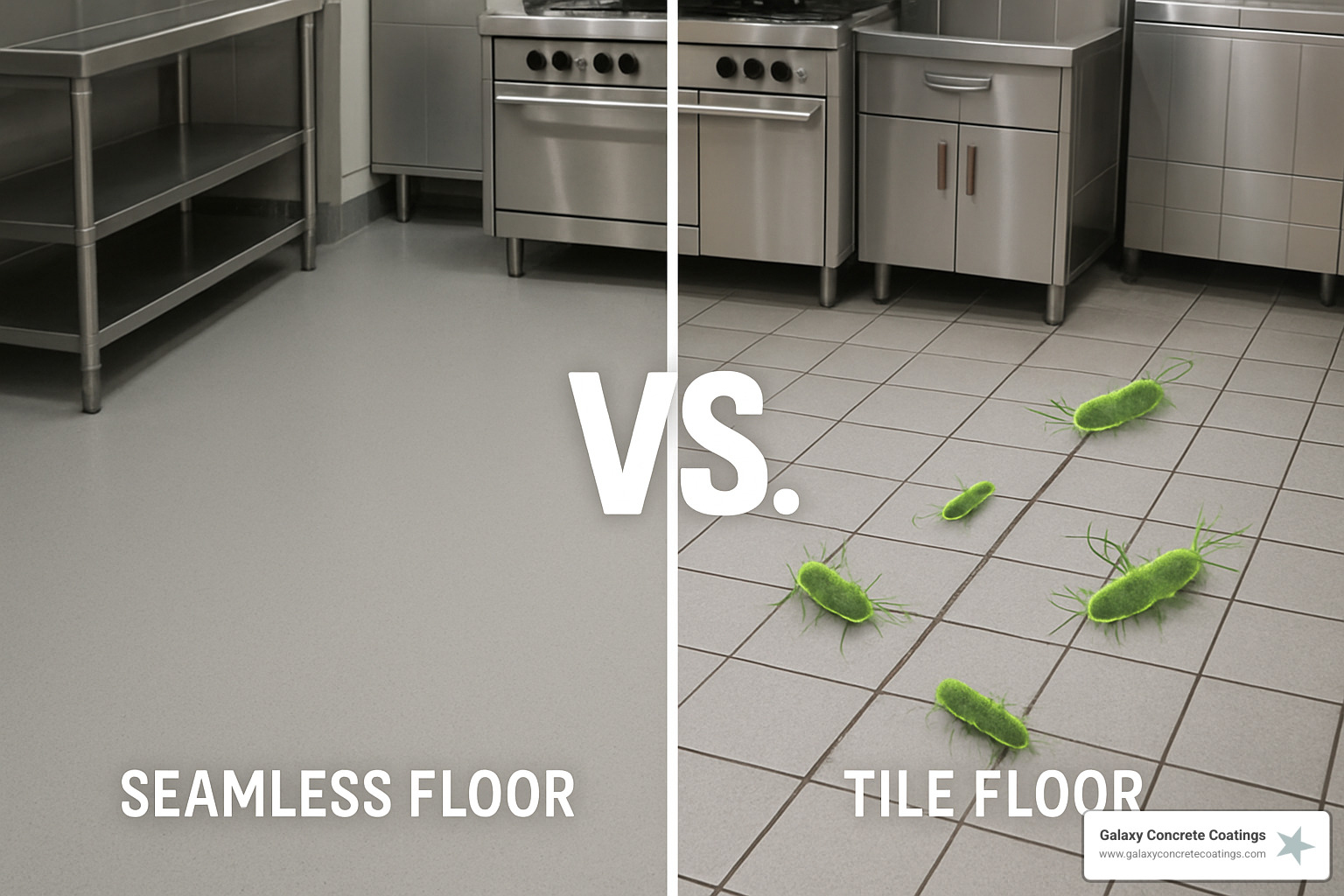
Perhaps most important for food safety is the seamless nature of our installations. Unlike tile with grout lines that become breeding grounds for bacteria, our polyaspartic coatings create a continuous, non-porous surface that’s dramatically easier to clean and sanitize.
| Feature | Standard Epoxy | Urethane Cement | Galaxy’s Polyaspartic |
|---|---|---|---|
| Cure Time | 3-7 days | 24-48 hours | 24 hours or less |
| Chemical Resistance | Good | Very Good | Excellent |
| Thermal Shock | Poor-Fair | Excellent | Very Good |
| Impact Resistance | Good | Excellent | Excellent |
| Slip Resistance | Variable | Good | Excellent (customizable) |
| Installation Downtime | 3-7 days | 2-3 days | 1 day |
| UV Stability | Poor | Good | Excellent |
| Maintenance | Moderate | Low | Very Low |
Key Performance Features Every Chef Needs
Slip Resistance: Safety First
Chef Miguel from a busy restaurant in Phoenix couldn’t contain his relief after upgrading to our floor system: “The first time I walked on our new kitchen floor during a busy service, I knew we’d made the right choice. Even with oil and water on the floor, no one was sliding around like before.”
Slip resistance isn’t just a nice-to-have – it’s essential. Industry standards require a minimum Coefficient of Friction (COF) of 0.42 for commercial kitchens, but Galaxy’s polyaspartic coatings exceed this standard easily. We can customize the texture level to match your specific needs, broadcasting non-slip aggregate lightly in some areas and more heavily around cooking stations and dish pits where slip hazards are greatest.
Heat Tolerance: Standing Up to Kitchen Infernos
The temperature extremes in commercial kitchens would destroy ordinary flooring. When a line cook accidentally spills hot oil or boiling water, your floor needs to take it in stride. Our polyaspartic coatings withstand direct contact with substances up to 350°F without degrading – giving you peace of mind during the kitchen chaos.
USDA/FDA Compliance: Meeting Regulatory Standards
Ask any restaurant owner about health inspections, and you’ll likely see them wince. But our clients have a different experience. Health inspectors “love” seamless floor systems with cove bases, according to industry experts we’ve worked with. Our polyaspartic coatings are fully USDA and FDA compliant, meeting all requirements for food processing and preparation areas. The seamless installation eliminates those troublesome grout lines and crevices where bacteria love to hide – often a critical factor during health inspections.
Maintenance Ease: Clean and Go
“I used to assign staff an extra hour just to deep-clean our old tile floor,” a kitchen manager from Indianapolis told us after switching to polyaspartic. “With our new coating, we just mop and go—it’s saving us time and money every day.”
The non-porous nature of our coatings means spills stay on the surface instead of seeping into the concrete. A simple daily cleaning routine with a deck brush and squeegee is typically all that’s required, letting your staff focus on food, not floor maintenance.
Material Showdown: Epoxy, Urethane Cement, Polyaspartic
Epoxy Basics: The Traditional Choice
Epoxy has been the industry standard for decades, and it offers decent chemical resistance at a relatively economical price point. But let’s be honest about its limitations:
The cure time stretches to 3-7 days, meaning your kitchen faces extended downtime. UV exposure causes yellowing over time, particularly near windows or open kitchen concepts. Its thermal shock resistance is limited, making it vulnerable in areas near cooking equipment. And moisture issues during installation can lead to premature failure.
As one food processing facility manager bluntly put it: “Standard epoxies simply don’t hold up in our environment—they were literally peeling off the floor after six months of exposure to our cleaning protocols.”
Urethane Cement Strengths: The Heavy-Duty Option
For extreme environments, urethane cement systems have earned their reputation as tough performers. They offer outstanding thermal shock resistance, excellent chemical resistance, and can be applied to damp concrete. They’ll withstand heavy impacts that would damage other coatings.
The trade-offs? Urethane cement typically requires professional installation, costs more than standard epoxy, and still needs 24-48 hours of cure time before you can resume full kitchen operations.
Polyaspartic: The Galaxy Advantage
Polyaspartic coatings represent the next generation of commercial kitchen floor coatings, and they’re our specialty at Galaxy. They offer a constellation of advantages:
The one-day installation and cure time minimizes your kitchen’s downtime – often the deciding factor for busy restaurants that can’t afford extended closures. Their superior UV stability means no yellowing, even in areas with natural light. The excellent chemical and stain resistance handles everything from wine to cleaning agents without flinching. The material’s inherent flexibility helps prevent cracking as your building settles or shifts slightly. And the customizable slip resistance lets us tailor the floor’s texture to different areas of your operation.
“After researching all the options, polyaspartic was the clear winner for our 24/7 operation,” explained a food production facility director who chose Galaxy. “The one-day installation meant we could coat the floor overnight and be back in production the next morning—that alone justified the investment.”
Why Commercial Kitchen Floor Coatings Need Slip Resistance
The statistics don’t lie – slip and fall accidents rank among the most common workplace injuries in commercial kitchens. These incidents result in costly workers’ compensation claims, lost productivity, and staffing challenges. A properly designed slip-resistant floor coating is your first line of defense against these risks.
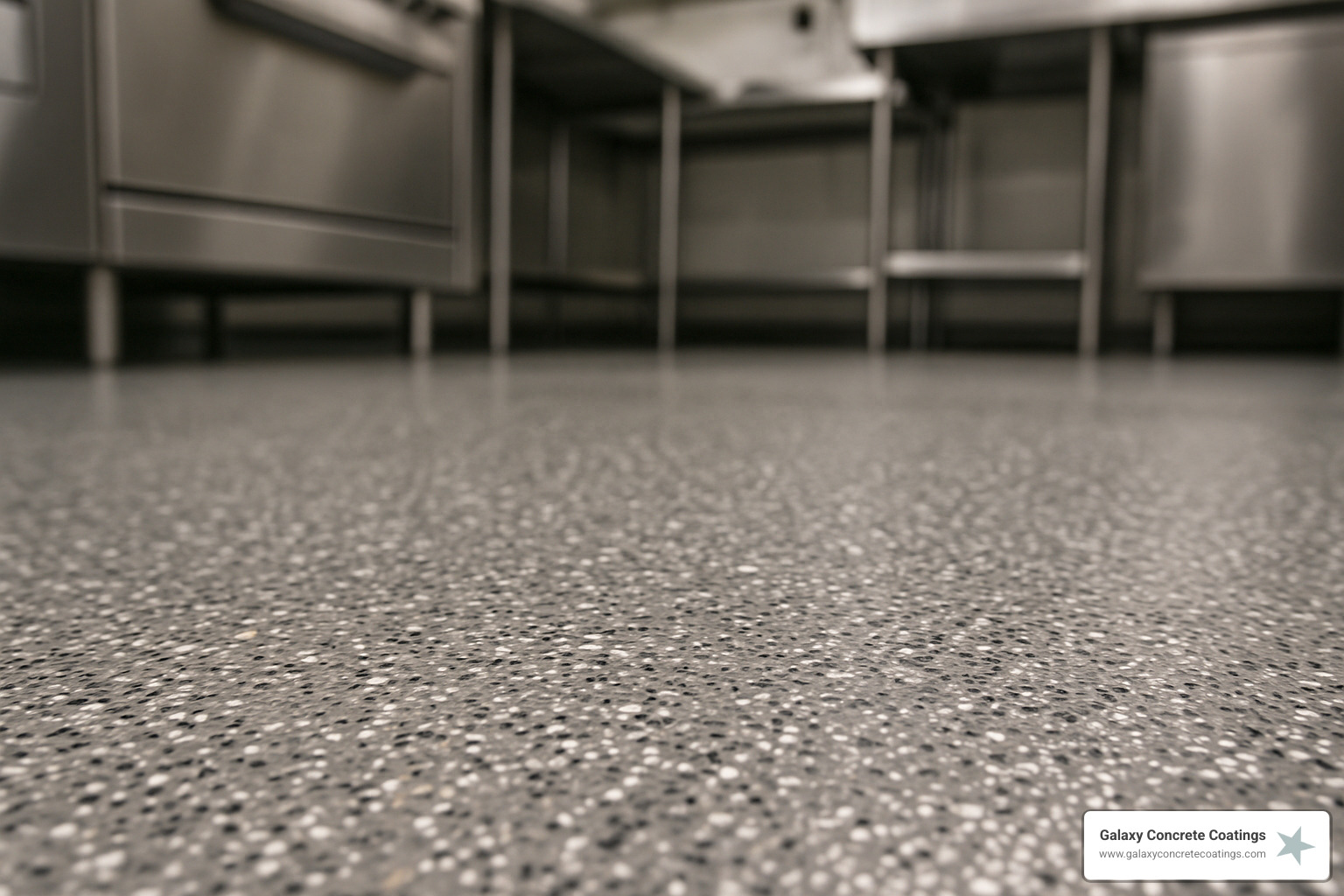
COF Ratings: The Science of Slip Prevention
The Coefficient of Friction (COF) isn’t just technical jargon – it’s the measurable standard that determines how slip-resistant your floor truly is. The Americans with Disabilities Act recommends a minimum COF of 0.6 for accessible routes. OSHA suggests a minimum of 0.5 for workplace walking surfaces. The National Floor Safety Institute considers a COF of 0.42 or greater as “high traction.”
Our team customizes your polyaspartic coating’s slip resistance for specific areas based on their unique challenges:
Cooking stations receive heavy texture to combat oil and grease exposure. Prep areas get medium texture for wet but not greasy environments. Walk-in coolers benefit from improved texture to prevent slips on condensation. And dining areas receive light texture that balances safety with cleanability and aesthetic appeal.
Textured Quartz: Beauty Meets Safety
When your floor needs to be both safe and stunning – particularly in areas visible to customers – we can incorporate colored quartz aggregate. This provides reliable slip resistance while adding visual depth and interest to the floor. The result is a surface that protects your staff while enhancing your restaurant’s ambiance.
Grease Zones: Extra Protection Where It’s Needed Most
Areas around fryers and grills create special challenges. We can apply additional layers of slip-resistant aggregate in these “grease zones” while maintaining a consistent appearance throughout the kitchen. This targeted approach ensures maximum safety in high-risk areas without compromising the floor’s overall look and feel.
Anti-Fatigue Mats: The Perfect Complement
While our polyaspartic coatings provide excellent slip resistance, we recommend strategic use of anti-fatigue rubber mats at workstations. These offer complementary benefits:
They improve comfort for staff standing for long periods, reducing fatigue and improving morale. They provide extra slip protection in high-risk areas. And they reduce wear on the coating in high-traffic zones, extending your floor’s lifespan.
A restaurant owner in Denver shared this insight: “The combination of your polyaspartic coating with strategic anti-fatigue mats has eliminated slip accidents in our kitchen while reducing staff complaints about foot and back pain.”
Back-of-House vs Front-of-House Demands
Your commercial kitchen doesn’t operate in isolation – it’s often part of a larger facility with different flooring needs in different areas. Back-of-house (BOH) and front-of-house (FOH) spaces each present unique challenges that require thoughtful solutions.
BOH Heavy Traffic: Function Over Form
In back-of-house areas, performance is paramount. These spaces need maximum durability under constant foot traffic and equipment movement. They require chemical resistance against harsh cleaning agents and thermal shock resistance near cooking equipment. High slip resistance in wet areas is non-negotiable, and seamless installation ensures proper hygiene and easy cleaning.
“In our BOH areas, we need a floor that can take a beating,” explained a corporate kitchen designer who partners with Galaxy. “Aesthetics take a backseat to performance—we need something that won’t fail when a 350°F pot of oil hits the floor.”
FOH Aesthetics: Where Style Meets Substance
Front-of-house areas must balance performance with appearance. These spaces need attractive finishes that complement the restaurant’s design while providing appropriate slip resistance for customer safety. They require durability in high-traffic paths and easy maintenance to maintain appearance. Many clients also value sound-dampening properties in dining areas to improve the customer experience.
Our polyaspartic coatings excel in both environments, with customizable appearance options for FOH while maintaining the durability needed throughout the facility.
Branding Colors: Floor as Part of Your Identity
“We wanted our floor to reflect our brand colors and create a cohesive look,” noted a restaurant owner in Cincinnati after working with our team. “Galaxy delivered a custom blue that perfectly matches our logo while providing all the performance benefits we needed.”
Our polyaspartic coatings come in a spectrum of colors, allowing restaurants to incorporate branding elements directly into the floor design. Our custom color matching ensures perfect alignment with your existing color scheme, turning your floor into an extension of your brand identity.
Hybrid Systems: The Best of All Worlds
For operations with diverse needs across different areas, we create hybrid systems that use different coating formulations in different zones:
We install heavy-duty polyaspartic in cooking and prep areas where performance is critical. Decorative chip or quartz systems improve dining areas where aesthetics matter. And specialized formulations protect walk-in coolers and freezers from their unique challenges.
This approach ensures optimal performance throughout your facility while maintaining a cohesive appearance that flows naturally from one area to the next.
How Floor Coatings Support Food-Safety Compliance
In the food service industry, health code compliance isn’t a suggestion – it’s essential for staying in business. Your floor coating plays a crucial but often overlooked role in meeting these requirements.
HACCP: Hazard Analysis Critical Control Points
HACCP principles help identify potential food safety hazards and establish preventive measures. Proper floor coatings support HACCP by eliminating harborage points for bacteria and pests. They facilitate thorough cleaning and sanitization procedures. They prevent contamination from floor deterioration and support proper drainage to prevent standing water.
Choosing HACCP-International certified floor coatings provides assurance that your flooring meets global food safety standards – something health inspectors notice immediately.
USDA & FDA: Meeting Federal Requirements
Both the USDA and FDA maintain specific requirements for floors in food processing and preparation areas. These include non-absorbent, washable surfaces that resist food acids, cleaners, and sanitizers. Proper slope for drainage is essential, as are coved bases at wall junctions.
Our polyaspartic coatings meet or exceed all these requirements, providing peace of mind during inspections and protecting your operation from potential violations.
Seamless Cove Base: The Critical Junction
The junction between floor and wall represents a critical area for hygiene. Our seamless cove base installation creates a continuous, waterproof “tub” that eliminates corners where bacteria can hide. It prevents water from seeping behind walls, simplifies cleaning and sanitization, and improves overall hygiene compliance.
“Health inspectors immediately notice and appreciate a properly installed cove base,” notes a food safety consultant we work with regularly. “It’s one of those details that signals your commitment to proper food safety protocols.”
Antimicrobial Additives: Extra Protection
For maximum food safety, our coatings incorporate EPA-registered antimicrobial additives that inhibit the growth of bacteria, fungi, mold, and mildew. These provide continuous protection between cleanings and remain effective throughout the coating’s lifetime.
Unlike surface treatments that wear off over time, these additives are integrated throughout the coating thickness for long-lasting protection – creating an invisible shield against contamination between regular cleaning cycles.
Installation, Maintenance & ROI: Keeping Your Floors Stellar
There’s more to commercial kitchen floor coatings than just getting them installed. Understanding the complete journey—from installation day through years of service—helps you make smarter decisions that maximize your investment and minimize headaches.
Installing Over Existing Tile, Concrete, or Wood
“Do we have to rip out our existing floor?” This is probably the most common question we hear, and we love giving the answer: usually not! This can save you thousands in demolition costs and days of downtime.
Minimal Prep Primers: The Game Changer
Traditional epoxy installations often require aggressive surface preparation that creates dust, noise, and extends your downtime. Our advanced polyaspartic systems use specialized primers that revolutionize the process:
“We were absolutely certain we’d need to remove all our quarry tile,” shares Maria, a restaurant manager from Tucson. “When your team explained you could coat right over it with just basic cleaning and prep, we were skeptical. But here we are a year later with a beautiful, seamless floor that was installed in just one day!”
Our minimal-prep primers bond securely to properly cleaned existing surfaces, dramatically reducing installation time and mess. For many kitchens, this means closing after dinner service and reopening for lunch the next day—with a brand-new floor ready for action.
Bonding Agents: Ensuring Adhesion to Challenging Surfaces
Every kitchen floor is unique, and our approach adapts accordingly:
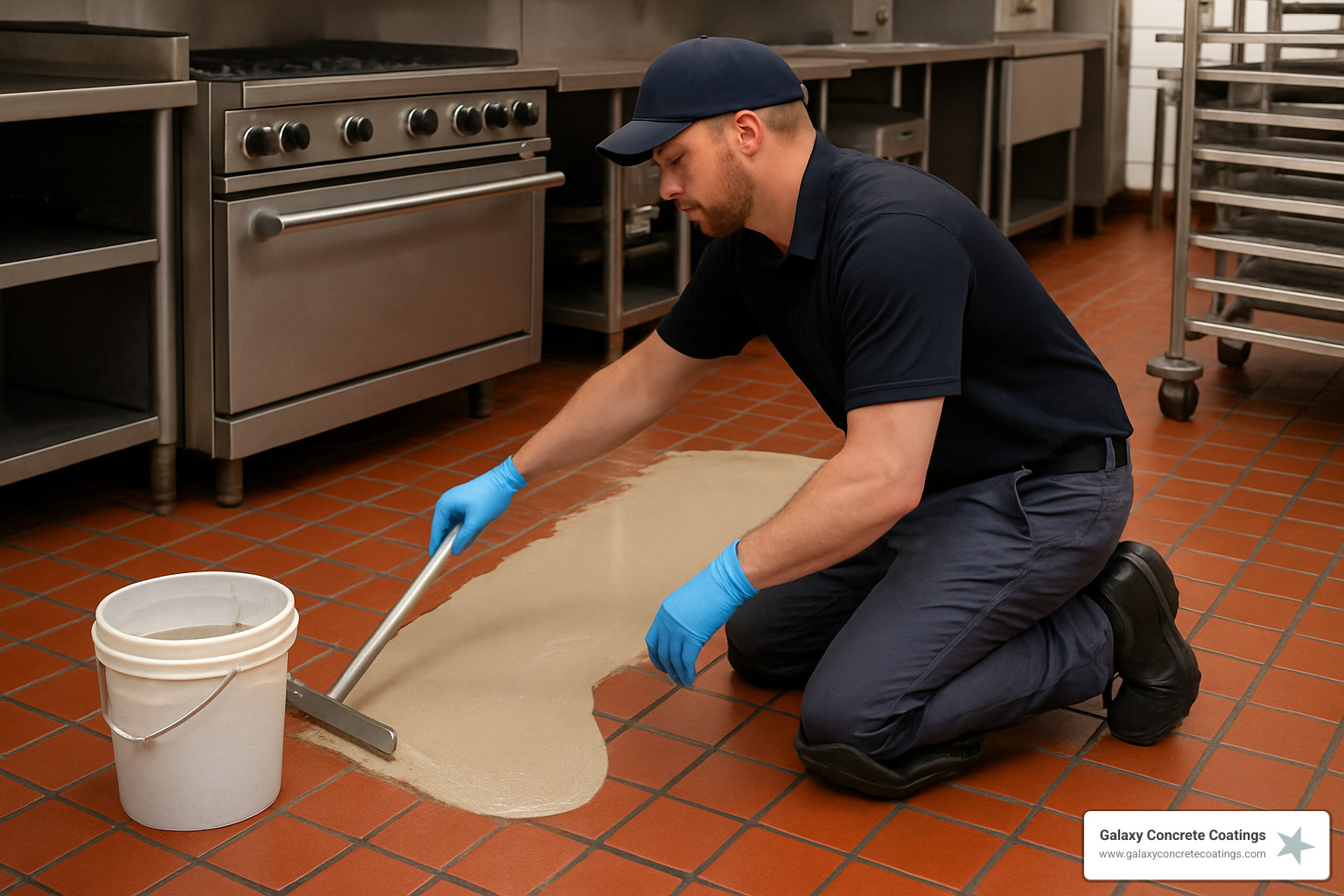
For existing tile floors, we use specialized bonding primers that create both mechanical and chemical bonds with ceramic, quarry, or porcelain surfaces. The key is thorough cleaning to remove oils and contaminants before application.
When working with concrete substrates, we test for moisture issues that could affect adhesion. For newer concrete or slabs with moisture concerns, we apply moisture mitigation systems that prevent future bubbling or delamination.
For wood subfloors in certain areas, we use flexible primers that accommodate natural movement while creating a secure bond. This prevents cracking as the wood expands and contracts.
Cove Base Creation: The Hygiene Detail That Matters
Health inspectors notice the details, especially where floors meet walls. That’s why we create seamless cove bases as part of our installation:
“The cove base was a game-changer for our health inspections,” notes a deli owner in Denver. “Our inspector specifically commented on how much better it was than our old square corners that collected grime.”
Our installation process creates this critical hygiene feature by:
- Carefully preparing the wall-floor junction
- Applying specially formulated epoxy mortar to create the curved cove shape
- Coating the cove with the same polyaspartic material used on the floor
- Creating a continuous, waterproof transition from floor to wall
This seemingly small detail eliminates bacteria-harboring corners, prevents water damage to walls, and makes cleaning infinitely easier.
Cleaning & Maintaining Commercial Kitchen Floor Coatings
One of the biggest advantages of polyaspartic commercial kitchen floor coatings is their easy maintenance. Your staff will thank you, and your budget will too.
Daily Scrub: Simple Routine Cleaning
“I used to assign two staff members for an hour just to deep-clean our old quarry tile floor,” explains Chef James from Indianapolis. “Now one person can handle it in 15 minutes, and the floor actually gets cleaner.”
The daily maintenance routine is refreshingly simple:
- Sweep or vacuum to remove loose debris
- Apply a diluted pH-neutral cleaner (we’ll recommend specific products)
- Scrub with a deck brush to handle any stuck-on materials
- Rinse thoroughly and squeegee dry
This straightforward process keeps your floor looking great while maintaining its slip-resistant properties.
pH-Neutral Cleaners: Protecting Your Investment
Even space-age polyaspartic coatings need proper care. The cleaning products you use matter:
“We learned this lesson the hard way,” admits a kitchen manager from Phoenix. “We used a harsh degreaser that slowly dulled our floor’s finish. After switching to the recommended cleaner, the shine came back and has stayed.”
To protect your floor, we recommend:
- Using pH-neutral cleaners specifically designed for resinous floors
- Avoiding harsh chemicals like bleach, ammonia, or highly acidic cleaners
- Following dilution instructions carefully (more isn’t better!)
- Rinsing thoroughly to remove all cleaner residue
The right cleaning approach not only maintains appearance but extends the life of your coating by years.
Steam-Clean Limits: Know Your Boundaries
While our polyaspartic coatings can handle impressive heat (up to 350°F), certain cleaning methods can still cause damage over time:
“My staff was using a steam cleaner directly on the floor, thinking hotter was better,” shares a restaurant owner. “Your team explained this could eventually affect the coating, and we switched to your recommended cleaning method. Five years later, our floor still looks new.”
To preserve your floor’s stellar performance:
- Skip direct steam cleaning on the coating surface
- Keep pressure washer temperatures below 180°F
- Maintain at least 12 inches of distance when using pressure washers
- Limit exposure time to high temperatures
These simple guidelines prevent premature aging of your floor coating.
Scheduled Recoats: Proactive Maintenance
Even the most durable coating will eventually show wear in high-traffic areas. Smart maintenance planning includes:
“We have a maintenance calendar for everything in our kitchen,” notes a culinary director from Cincinnati. “Adding an annual floor inspection to that schedule has helped us address small issues before they become big problems.”
A proactive approach includes annual professional inspection to identify any concerns, spot repairs of damaged areas before they spread, refresh coats every 5-7 years in high-wear areas (like in front of fryers or prep stations), and complete recoating only when truly necessary.
Cost & Long-Term Value: Galaxy-Scale Savings
When evaluating commercial kitchen floor coatings, looking beyond the initial price tag reveals the true value of your investment.
Initial vs Life-Cycle Costs: The Complete Picture
“The polyaspartic system wasn’t the cheapest option upfront,” admits Frank, a multi-unit restaurant operator. “But after running the numbers on downtime, maintenance, and expected lifespan, it was clearly the most economical choice over a 10-year period.”
While polyaspartic coatings may have a higher initial cost than basic epoxy, the total ownership cost typically comes out lower for several reasons:
Your kitchen closes for just one day instead of 3-7 days with traditional epoxy, meaning significantly less revenue loss. The longer coating lifespan (15+ years versus 5-7 for basic epoxy) reduces how often you’ll need replacement. Lower maintenance requirements save on labor and cleaning supplies. And superior durability means fewer repairs and touch-ups over time.
When you calculate all these factors, the premium option often becomes the budget-friendly choice.
Slip-Claim Reduction: The Hidden Savings
The National Safety Council estimates the average slip-and-fall claim costs businesses $42,000. Proper slip-resistant flooring significantly reduces this risk:
“After installing your polyaspartic floor with the improved slip resistance package, we’ve gone three years without a single slip incident,” shares a food processing facility manager. “Our insurance company actually noted this in our last review.”
The financial benefits include potential insurance premium reductions with documented safety flooring, fewer worker’s compensation claims, decreased liability exposure, and improved workplace safety ratings. For many businesses, these savings alone justify investing in premium flooring.
Energy Reflectivity: Unexpected Benefits
One surprise benefit many customers find is improved lighting efficiency:
“Our kitchen seems so much brighter now,” notes a chef from Phoenix. “We actually reduced our lighting fixtures and still have better visibility than before.”
Light-colored, high-gloss floor coatings naturally improve light reflection, which can reduce lighting requirements, improve visibility and safety, potentially save on energy costs, and create a brighter, more positive work environment.
Warranty Factors: Protection for Your Investment
Galaxy Concrete Coatings stands behind our work with a lifetime warranty on our polyaspartic systems—something you simply won’t find with standard epoxy coatings. This warranty protects against manufacturing defects, covers premature wear under normal use, provides peace of mind for long-term budgeting, and demonstrates our confidence in our products.
When comparing costs between different options, be sure to factor in this valuable protection.
Customization & Branding Without Compromise
Modern commercial kitchen floor coatings offer aesthetic options that were impossible with traditional materials, allowing you to add personality and branding without sacrificing performance.
Color Chips: Practical Beauty
Decorative vinyl chips (or flakes) aren’t just for looks—they serve multiple practical purposes:
“We chose a blue chip blend for our seafood restaurant kitchen,” shares a restaurant owner. “Not only does it tie in with our ocean theme, but it also cleverly hides the inevitable blue crab splatter between cleanings!”
These chips hide dirt between cleanings, provide visual texture that complements slip resistance, come in hundreds of color combinations, and create a professional, finished appearance that lifts your entire space.
Metallic Swirls: Dramatic Front-of-House Floors
For customer-facing areas, especially in open kitchen concepts, metallic epoxy effects create stunning visual impact:
“Customers constantly ask about our floor,” says a brewery owner with an open kitchen design. “The copper metallic swirls match our brewing tanks and create this amazing dimensional effect that photographs beautifully for social media.”
These systems create a unique, three-dimensional appearance where no two floors are exactly alike, come in a wide range of colors, and can be sealed with polyaspartic for maximum durability in high-traffic areas.
Logo Inlays: Brand Reinforcement
For the ultimate in customization, we can incorporate your logo directly into the floor:
“Having our logo in the floor of our open kitchen has become part of our brand experience,” notes a restaurant manager. “It’s in countless customer photos on Instagram, essentially giving us free advertising.”
Using computer-cut templates ensures precise reproduction, multiple colors create exact logo matches, and clear polyaspartic sealing provides permanent protection for this powerful brand statement.
FOH Design Synergy: Cohesive Spaces
For operations with open kitchens or visible prep areas, coordinating front and back-of-house flooring creates design continuity:
“Our open kitchen concept means customers see everything,” explains a restaurant designer. “The consistent flooring with subtle texture differences between customer and staff areas creates a cohesive look while maintaining proper safety in each zone.”
This approach creates visual flow with consistent color schemes but varying texture levels, transitional designs between spaces, practical performance with aesthetic appeal, and custom colors that match your décor elements.
Extending the Life of Commercial Kitchen Floor Coatings
With proper care, your commercial kitchen floor coating can provide stellar service for many years. These proactive strategies help maximize your investment.
Routine Inspections: Catching Issues Early
The best maintenance strategy is preventing problems before they start:
“We do a quick floor inspection every Sunday during deep cleaning,” explains a kitchen manager. “Catching small issues early has prevented major problems and extended our floor’s life significantly.”
Regular inspection prevents small problems from becoming major repairs by incorporating weekly checks for signs of wear or damage, immediate attention to chips or cracks, documentation of problem areas for monitoring, and professional annual assessment.
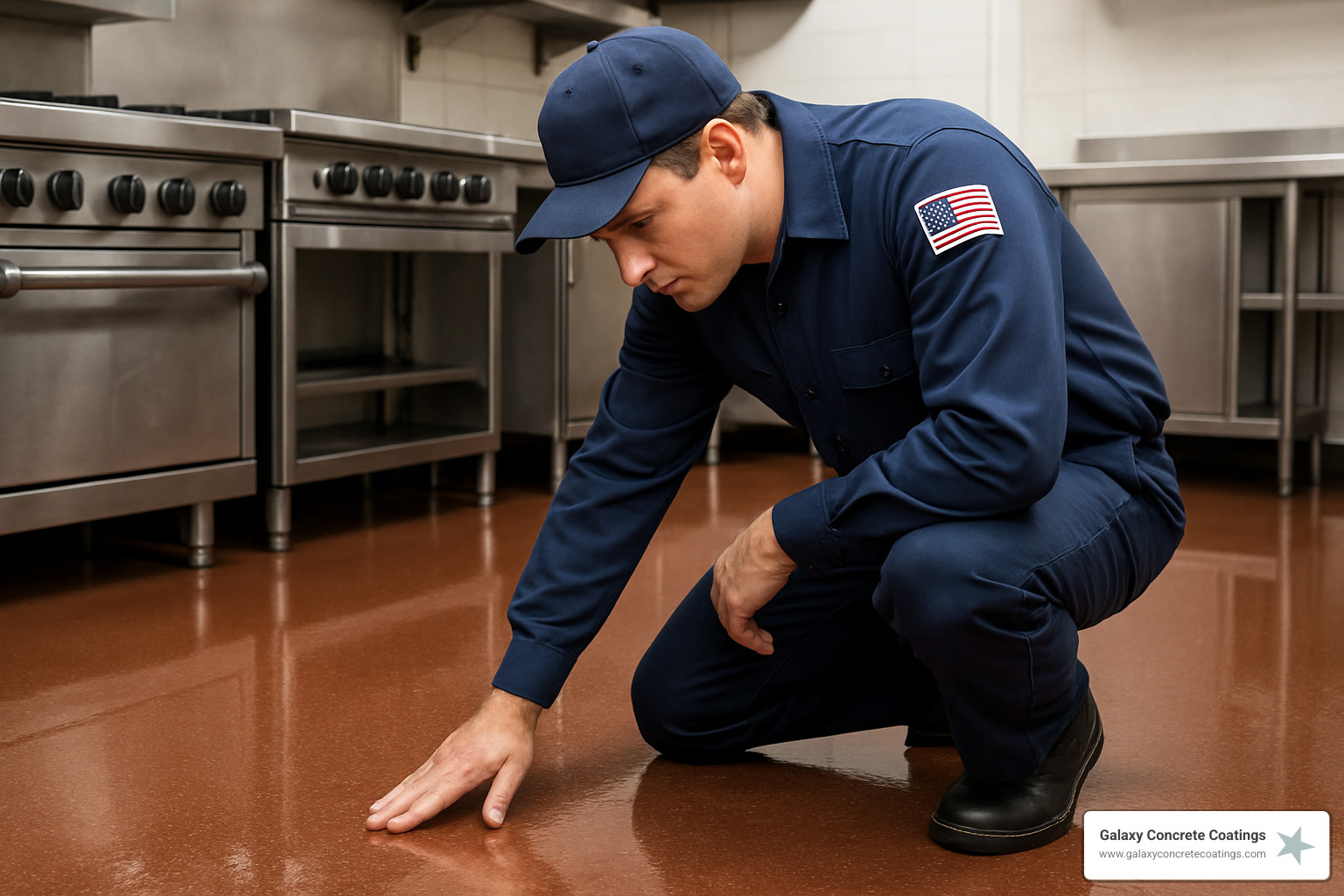
Quick Repairs: The Stitch-in-Time Approach
Prompt attention to damage prevents problems from spreading:
“One of our cooks dropped a heavy pot that chipped the floor,” recalls a chef. “We used the repair kit you provided that same day, and now you can’t even tell where the damage was.”
Our polyaspartic systems can be spot-repaired without visible transition lines—unlike many epoxy systems that require large-area recoating. We recommend keeping a small repair kit on hand for emergency fixes, addressing chips and cracks immediately to prevent water intrusion, scheduling professional repairs for larger issues, and documenting all repairs for warranty purposes.
Anti-Fatigue Mats: Dual-Purpose Protection
Strategic use of quality anti-fatigue mats serves two important purposes:
“Our staff love the anti-fatigue mats at their stations,” shares a culinary director. “What they don’t realize is those mats are also protecting our floor investment in high-traffic areas.”
Quality mats reduce coating wear in high-traffic zones, provide ergonomic benefits for staff, add slip protection in critical areas, and extend overall floor life. It’s a win-win for both comfort and longevity.
Proper Mats Cleaning: Often Overlooked
Dirty mats can actually damage your beautiful floor coating:
“We learned to flip our mats every night and wash them weekly,” notes a kitchen manager. “Before that, we’d find moisture trapped underneath that was affecting our floor finish.”
This often-overlooked maintenance step prevents premature wear and microbial growth. Be sure to clean mats regularly according to manufacturer instructions, allow them to dry completely before replacing, check under mats weekly for trapped moisture, and replace worn mats promptly to prevent coating damage.
At Galaxy Concrete Coatings, we’re committed to taking your commercial kitchen floor out of this world. Our stellar polyaspartic coatings are installed in just one day and backed by a lifetime warranty that gives you cosmic peace of mind. We proudly serve Denver, Phoenix, Tucson, Cincinnati, and Indianapolis. Want to learn more about our industrial-grade solutions? Blast off to more info about industrial coatings.
Conclusion
When it comes to commercial kitchen floor coatings, the right choice makes all the difference between constant headaches and smooth operations. At Galaxy Concrete Coatings, we’ve seen how our polyaspartic systems transform chaotic kitchen environments into stellar workspaces that stand up to whatever your chefs can throw at them (sometimes literally!).
Our one-day installation is a game-changer for busy restaurants and food service operations. Imagine closing up Sunday night and opening Monday morning with a completely transformed kitchen floor. That’s not science fiction—it’s the Galaxy difference. Many of our customers are amazed that such a durable solution doesn’t require shutting down their kitchen for days on end.
“It’s like walking on a floor from another galaxy,” one chef told us after we completed his kitchen installation. “Spills wipe right up, nothing stains it, and my staff stopped complaining about slipping.”
The lifetime warranty we offer speaks volumes about our confidence in these coatings. While standard epoxy might look good initially, our polyaspartic systems are engineered to withstand the cosmic forces of commercial kitchens—from thermal shock to chemical spills to constant foot traffic—for years without deteriorating.
What truly sets Galaxy Concrete Coatings apart is our understanding of the unique challenges commercial kitchens face. We don’t just apply a coating; we create a customized system that addresses your specific needs for slip resistance, chemical protection, and aesthetic requirements. Whether you need a utilitarian back-of-house solution or a stunning open-kitchen floor that impresses customers, we’ve got you covered.
Galaxy Concrete Coatings provides these out-of-this-world polyaspartic concrete floor coatings for commercial kitchens across Denver (https://maps.app.goo.gl/Puexf5x3GtjvLUmS6), Phoenix (https://maps.app.goo.gl/upq42kxRjiuyPgRV8), Tucson (https://maps.app.goo.gl/HCnsQJdchAAsKuHQ7), Cincinnati (https://maps.app.goo.gl/uTQD7CL9nRtSDNTV6), and Indianapolis (https://maps.app.goo.gl/o4jBAcVuGkrFhbBD9). Our five-star ratings and glowing testimonials shine brighter than distant stars, proving we’re light-years ahead of the competition when it comes to taking your concrete out of this world.
Ready to launch your commercial kitchen flooring into the stratosphere? Contact us today for a free consultation and quote. Your kitchen deserves nothing less than Galaxy-grade protection that will have your staff, health inspectors, and bottom line all giving you a universal thumbs-up.
More info about industrial coatings