

Ready, Set, Prep! Mastering Concrete Floor Surface Preparation
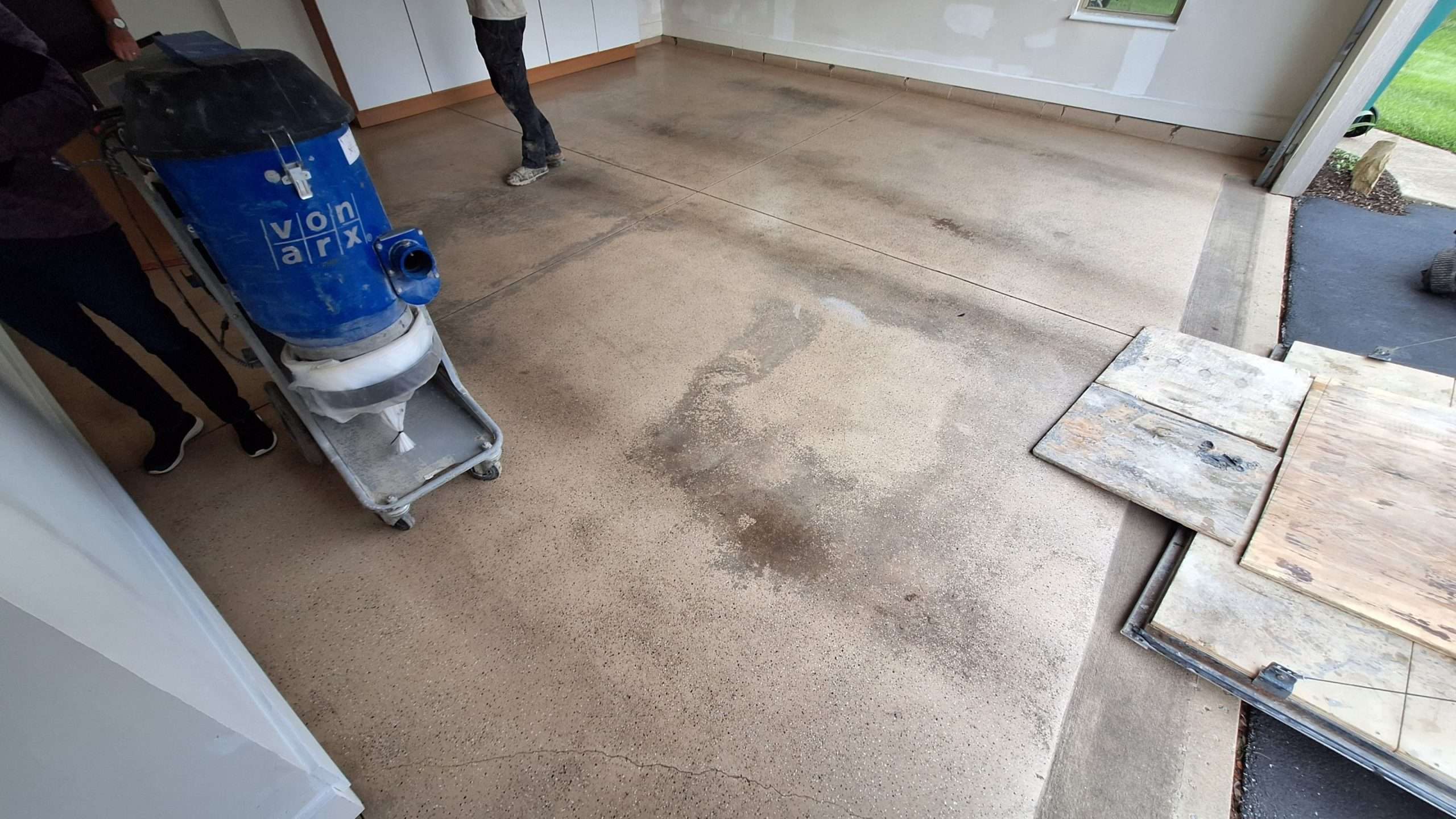
Why Concrete Floor Surface Preparation Is Your Coating’s Foundation
Concrete floor surface preparation is the critical first step that determines whether your coating will last decades or fail within months. Up to 80% of coating failures trace back to improper surface prep – making this the most important phase of any floor coating project.
Essential steps for concrete floor surface preparation:
- Assess substrate condition – Check for cracks, contamination, and structural soundness
- Clean and degrease – Remove oils, dirt, and chemical residues completely
- Create proper surface profile – Achieve CSP 3-5 through grinding or shot blasting
- Test moisture levels – Ensure ≤3 lbs/1000 sq ft/24 hrs vapor emission rate
- Repair defects – Fill cracks, spalls, and surface irregularities
- Final verification – Confirm readiness with pull-off adhesion testing
The research is clear: proper preparation is the linchpin of effective concrete repair. Whether you’re coating a residential garage, commercial kitchen, or industrial warehouse, the same fundamental principles apply. Skip or rush these steps, and even the best coating will eventually delaminate, bubble, or wear prematurely.
As Hayley Shahbazi, Galaxy Concrete Coatings Manager with expertise in concrete floor surface preparation across residential and commercial projects, I’ve seen how meticulous prep work separates successful installations from costly failures. Through years of perfecting our preparation protocols using advanced polyaspartic systems, I’ll guide you through the exact steps that ensure your coating bonds properly and performs for a lifetime.
Concrete floor surface preparation basics:
Concrete Floor Surface Preparation Mission Control: Step-by-Step Plan
When it comes to concrete floor surface preparation, Galaxy Concrete Coatings operates like a precision space mission. We’ve refined our process to stellar perfection, following industry standards including ICRI 310.2, ASTM F2170 for moisture testing, and SSPC SP 13 for surface preparation specifications.
Whether we’re preparing industrial warehouse floors where forklifts will roll, residential garages where families park their cars, or commercial kitchen surfaces where chefs will create culinary magic, our systematic approach ensures optimal adhesion for our advanced polyaspartic coating systems.
The secret to successful preparation lies in understanding that concrete isn’t just a uniform surface – it’s a complex material with varying porosity, strength, and contamination levels that can change from one square foot to the next. Our technicians treat each project like launching a spacecraft: thorough planning, precise execution, and zero tolerance for shortcuts that could compromise the mission.
Pre-Launch Inspection: Concrete Floor Surface Preparation Assessment
Before any grinding or blasting begins, we conduct what we call our “mission briefing” – a comprehensive visual survey of the concrete substrate. This critical first step identifies potential issues that could sabotage coating performance down the road.
Our technicians examine every inch of the surface, looking for cracks, spalls, and surface irregularities that need attention. We hunt for oil stains, grease spots, and chemical contamination that could prevent proper bonding. Previous coatings or sealers get flagged immediately, along with laitance – that weak, chalky surface layer that forms during concrete curing.
We use hammer sounding techniques to assess substrate soundness, a tried-and-true method where we tap the surface systematically. Solid concrete produces a sharp, clear ring, while weak or delaminated areas sound dull and hollow. These problem zones require removal before we can proceed.
For critical applications like manufacturing floors or commercial kitchens, we perform tensile pull-off testing to verify the concrete’s surface strength. The minimum acceptable pull-off strength is 218 psi, with higher values preferred for heavy-duty applications. We also verify that compressive strength reaches at least 3,626 psi for most coating applications.
Decontamination & Cleaning Protocol
Here’s where many coating failures begin – inadequate cleaning. Even microscopic amounts of oil, grease, or chemical residues can prevent proper adhesion, turning your beautiful new floor into a peeling disaster. Our systematic cleaning protocol ensures every square inch meets our stringent cleanliness standards.
We start with initial debris removal, sweeping and vacuuming all loose materials. Then comes degreasing treatment using high-alkaline detergent solutions specifically designed to break down oils and greases at the molecular level. Mechanical scrubbing with rotary equipment and appropriate brushes follows, working the cleaning solutions deep into the concrete’s pores.
For stubborn contaminants, especially in food processing facilities, we deploy steam cleaning equipment that reaches temperatures hot enough to break down even the most persistent residues. HEPA vacuuming removes all cleaning residues and particles, leaving behind a pristine surface.
The final step is our pH test using distilled water and pH paper. We need to verify surface pH reaches ≥11 because contaminants typically lower concrete’s natural alkalinity. If our test shows pH ≤10, we repeat the cleaning process until proper alkalinity is restored, ensuring the concrete surface is chemically ready for our polyaspartic coating.
For more detailed information about our comprehensive approach, check out our concrete floor installation process.
Achieving the Right Concrete Surface Profile (CSP)
Creating the proper Concrete Surface Profile is both an art and a science. The ICRI defines CSP levels from 1 to 10, with most coating applications requiring CSP 3-5. This range provides optimal mechanical bonding without creating excessive surface roughness that could show through thin coatings.
Shot blasting is our preferred method for most applications, creating CSP 3-7 depending on equipment settings. It’s fast, uniform, and removes contaminants simultaneously. Diamond grinding gives us precise control for CSP 2-5 applications, though it’s slower and requires careful technique to avoid polishing the surface. Scarifying handles heavy-duty applications requiring CSP 4-9 but can cause microcracking if not done properly. Acid etching only achieves CSP 1-2 and has safety concerns, so we rarely use it.
| Method | CSP Range | Advantages | Disadvantages |
|---|---|---|---|
| Shot Blasting | 3-7 | Fast, uniform, removes contaminants | Equipment intensive, dust generation |
| Diamond Grinding | 2-5 | Precise control, minimal dust | Slower, may polish surface |
| Scarifying | 4-9 | Aggressive removal, versatile | Can cause microcracking |
| Acid Etching | 1-2 | Simple, inexpensive | Limited profile, safety concerns |
Our technicians use ICRI comparator chips to verify the achieved CSP level matches project specifications. These standardized reference tools ensure consistency across all our installations, whether we’re in a Phoenix warehouse or a Cincinnati commercial kitchen.
For more information about surface preparation techniques, visit Concrete Surface Preparation – How to Prepare Floors for Resurfacing.
Moisture & pH Checks: Avoid Vapor Failures
Moisture-related coating failures are among the most expensive to repair because they often require complete removal and reinstallation. Nobody wants to see their beautiful floor bubbling and peeling because we skipped proper moisture testing. Our comprehensive moisture testing protocol follows ASTM standards to ensure long-term coating performance.
ASTM F1869 (Calcium Chloride Test) measures moisture vapor emission rate over 60-72 hours. We need to see ≤3 lbs/1000 sq ft/24 hrs maximum emission rate, with three tests required for the first 1,000 square feet and one additional test per 1,000 square feet thereafter.
ASTM F2170 (Relative Humidity Test) uses in-situ probes placed at 40% of slab depth, requiring a 72-hour acclimation period. This method is more accurate for thick slabs and provides ongoing monitoring capability throughout the installation process.
Critical considerations include ensuring new concrete cures a minimum 28 days before testing, maintaining dew point 5°F below surface temperature during application, and keeping environmental conditions stable throughout the testing period. Vapor barriers may be required for slabs on grade in high-moisture environments.
We also verify pH levels using distilled water and pH paper. Proper concrete pH ≥11 indicates the absence of contaminants and confirms the surface’s chemical readiness for coating application.
Understanding the superiority of polyaspartic coatings over traditional systems is crucial here. Our polyaspartic systems are more tolerant of minor moisture variations and cure faster, reducing the risk of moisture-related issues. Learn more about these advantages at our polyaspartic vs epoxy comparison.
Crack, Spall, and Joint Repairs
Even minor surface defects can telegraph through coatings and create failure points. Our repair protocol addresses every imperfection to create a uniform, sound substrate that will support our polyaspartic coating system for decades.
Crack repair starts with routing cracks to create uniform width and depth, followed by cleaning out all loose material and debris. We apply low-modulus epoxy or polyurea filler to accommodate natural concrete movement, achieving Saturated Surface Dry (SSD) condition before application. We overfill slightly and sand flush when cured for a seamless finish.
Spall repair requires removing all loose and weak concrete first, then creating square edges with mechanical tools. We apply bonding agent when specified and fill with high-strength repair mortar that matches the surrounding concrete’s properties. Edge shaving ensures smooth transitions that won’t show through the coating.
Joint treatment requires special attention because these areas experience the most movement and stress. We clean joints thoroughly of all debris and old sealants, evaluate joint condition and movement potential, then apply appropriate flexible sealants or leave unbonded depending on the application. Joint edges get properly beveled to prevent coating buildup that could crack or peel.
The key to successful repairs is matching the repair material’s properties to the existing concrete. We use low-shrinkage, high-bond-strength materials that cure to similar hardness as the surrounding substrate.
For comprehensive information about joint repairs, visit our detailed guide on concrete floor joint repair.
Final Verification: Concrete Floor Surface Preparation Readiness Check
Before applying any coating, we conduct a final verification process to ensure every aspect of preparation meets our stellar standards. This systematic check prevents costly callbacks and ensures optimal coating performance that will make your floor truly out of this world.
Our plastic sheet moisture test involves taping 12″×12″ plastic sheets to random locations and waiting 24 hours to check for condensation. Any moisture indicates incomplete drying and requires additional time before proceeding.
ICRI comparator verification confirms CSP level matches specifications across the entire surface. We document results with photographs and measurements for our quality records. Pull-off adhesion testing verifies substrate tensile strength exceeds 218 psi minimum, with repairs achieving proper bond strength throughout.
Cleanliness verification includes a white cloth wipe test for residual contaminants and final pH verification ≥11. We conduct visual inspection under proper lighting to catch any issues before coating application.
Environmental confirmation ensures surface temperature stays 5°F above dew point, relative humidity remains <80%, and temperature falls within coating specification range (typically 60-85°F).
Only when every verification step passes do we proceed to coating application. This attention to detail is why Galaxy Concrete Coatings can offer a lifetime warranty on our installations.
For industry-standard specifications and detailed technical information, reference the ICRI 310 Concrete Specifying Pack.
Countdown to Coating: Blast Off With Galaxy Concrete Coatings
After perfecting your concrete floor surface preparation, it’s time to launch into the coating phase with Galaxy Concrete Coatings. We’ve spent years refining our installation process to deliver results that are truly stellar. Our meticulous preparation combined with advanced polyaspartic technology creates floors that perform at light speed for decades.
The difference between a good coating job and an extraordinary one comes down to the coating system itself. While many contractors still rely on outdated coating technology, Galaxy has acceptd the future with polyaspartic coatings that outperform traditional systems in every measurable way.
Why Galaxy’s Polyaspartic Systems Launch Past Traditional Coatings:
Our polyaspartic coatings cure in lightning-fast time – we complete most installations in a single day compared to multi-day projects that disrupt your life or business operations. The superior chemical resistance means your floors withstand harsh chemicals, oils, and acids without breaking down or staining. Unlike traditional coatings that yellow and fade, our coatings maintain UV stability even under direct sunlight exposure.
Temperature extremes that would compromise other coatings don’t faze our polyaspartic systems. They perform flawlessly in both scorching heat and freezing cold conditions. Most importantly, they’re four times stronger than traditional coatings, delivering superior abrasion and impact resistance that keeps your floors looking pristine year after year.
Our exclusive position as a leading dealer for advanced coating systems means you’re getting the most advanced coating technology available. This recognition didn’t happen by accident – it’s the result of our cosmic-level commitment to proper concrete floor surface preparation and flawless application techniques.
Every Galaxy installation comes with our lifetime warranty because we know our preparation and application processes are out of this world. When you combine stellar surface prep with superior coating technology, the results speak for themselves.
Our Galaxy of Service Areas:
We’re proud to serve concrete coating needs across multiple states with our constellation of expert technicians:
- Denver, [Colorado](https://galaxyconcretecoatings.com/colorado/denver/)
- Phoenix, [Arizona](https://galaxyconcretecoatings.com/arizona/phoenix/)
- Tucson, [Arizona](https://galaxyconcretecoatings.com/arizona/tucson/)
- Cincinnati, [Ohio](https://galaxyconcretecoatings.com/ohio/cincinnati/)
- Indianapolis, [Indiana](https://galaxyconcretecoatings.com/indiana/indianapolis/)
Whether you need residential garage floors, commercial kitchen surfaces, or industrial warehouse coatings, our team delivers the same astronomical attention to detail. Learn more about our comprehensive coating options at our concrete coating types page.
Concrete floor surface preparation sets the foundation, but it’s our stellar reputation built on thousands of satisfied customers that truly sets Galaxy apart. When you’re ready to take your concrete floors out of this world, trust our team to deliver preparation and installation that’s simply cosmic. With five-star reviews across all our service areas and results that are written in the stars, Galaxy Concrete Coatings transforms ordinary concrete into extraordinary surfaces that shine brighter than the Milky Way and perform at warp speed for a lifetime.