

Walk This Way—Timing Your First Steps on Polyaspartic Floor Coatings
The Quick Countdown: From Coating to Walking
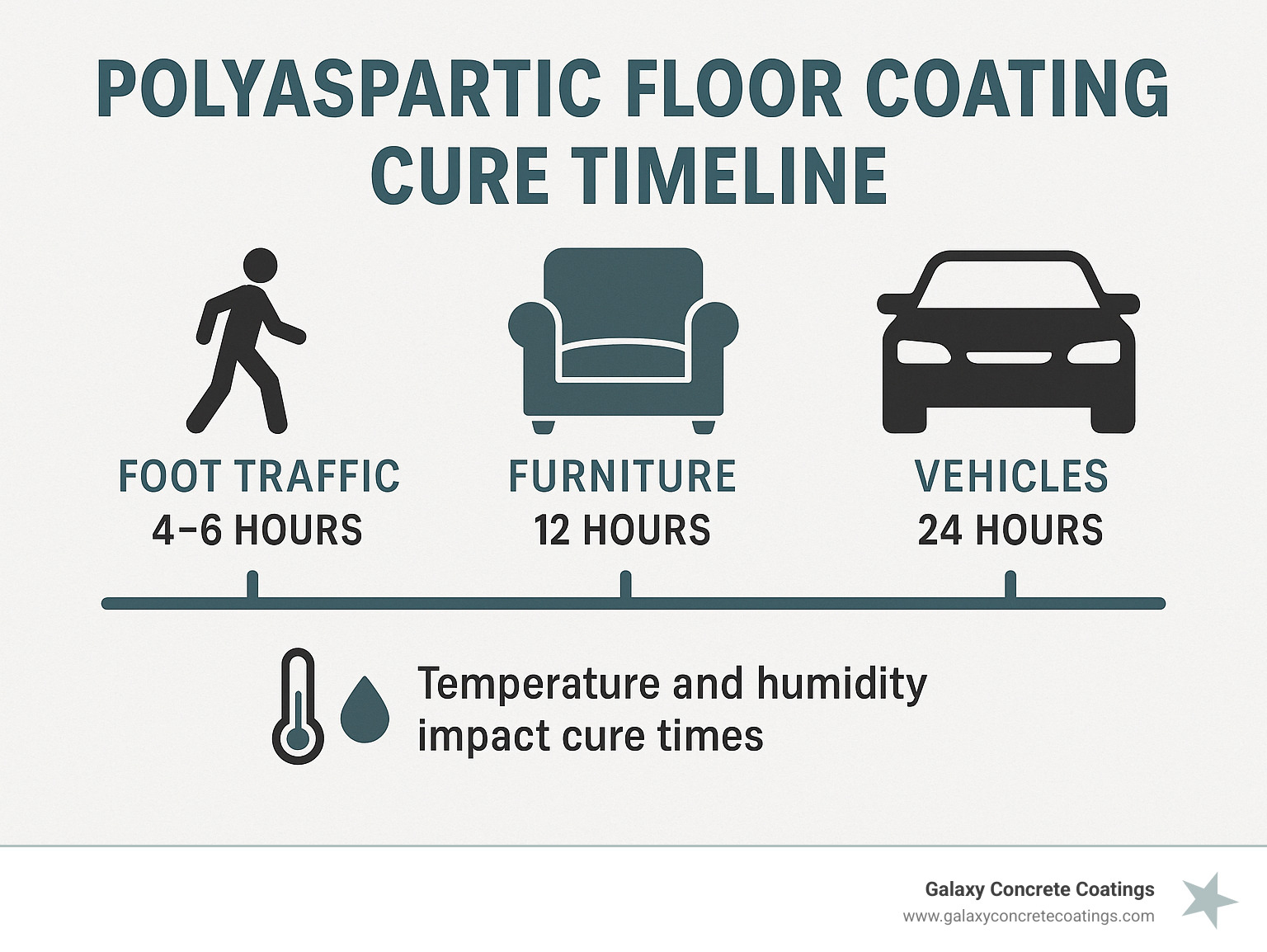
How long before you can walk on polyaspartic floor coating depends on several factors, but here’s the quick answer you’re looking for:
| Activity | Wait Time |
|---|---|
| Light Foot Traffic | 4-6 hours |
| Medium-Weight Items | 12 hours |
| Heavy Furniture | 24 hours |
| Vehicles/Heavy Equipment | 24-48 hours |
You’ve just invested in a beautiful new polyaspartic floor coating, and now comes the hardest part – waiting to use it. Unlike traditional epoxy that can keep you waiting for days, polyaspartic coatings offer lightning-fast cure times that get you back to using your space in hours, not days.
Whether you’re coating a garage floor that needs to house your vehicle by evening, or a basement that’s central to your family’s activities, knowing exactly when you can safely walk on your new floor is crucial.
I’m Hayley Shahbazi, Galaxy Concrete Coatings Manager with extensive experience helping homeowners understand how long before you can walk on polyaspartic floor coating to ensure maximum durability and performance of their investment.
Polyaspartic vs. Epoxy—Why Speed-of-Light Matters
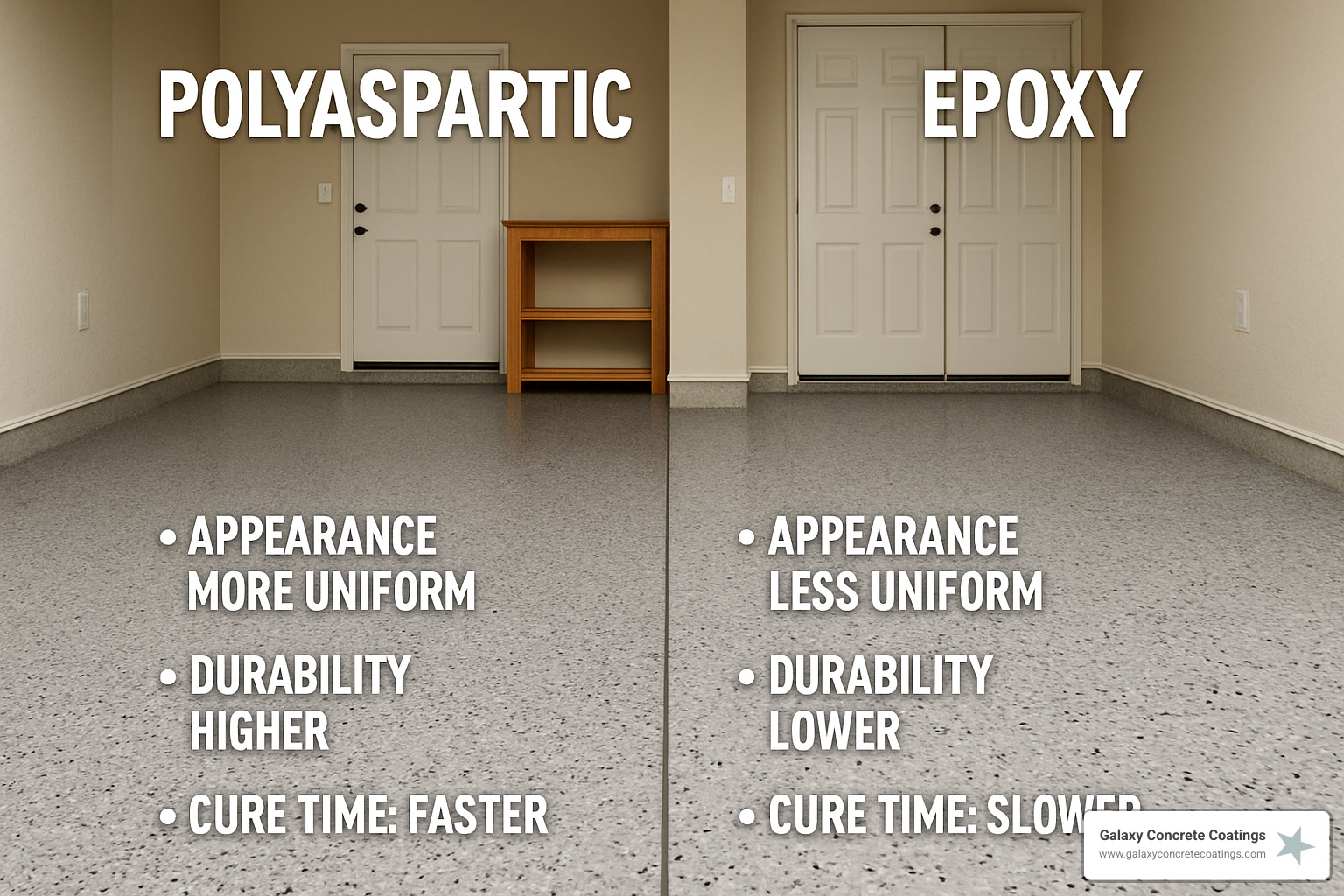
When you’re choosing a concrete floor coating, the difference between polyaspartic and epoxy isn’t just technical—it’s the difference between getting your life back the same day or waiting around for a week. Think of polyaspartic as the spacecraft of floor coatings while epoxy is still traveling by horse and buggy.
At Galaxy Concrete Coatings, we exclusively offer polyaspartic coatings because we believe your time is valuable. Take a look at how these stellar options compare:
| Feature | Polyaspartic | Epoxy |
|---|---|---|
| Walk-on Time | 4-6 hours | 24+ hours |
| Full Use Time | 24 hours | 7+ days |
| UV Stability | Excellent | Poor (yellows) |
| Abrasion Resistance | 4× stronger | Moderate |
| Temperature Range | -30°F to 140°F | 55°F+ only |
| Installation Time | 1 day | 3-5 days |
I’ve seen the relief on homeowners’ faces countless times when they learn they won’t have to relocate their entire family for days on end. As one of our installation experts puts it, “After installing coatings multiple times per week over several years, I’ve observed that polyaspartic’s rapid cure time is a game-changer for homeowners who can’t afford to have their space out of commission.”
The Chemistry Behind the Warp-Speed Cure
So what makes polyaspartic coatings cure at warp speed? It’s not magic—it’s chemistry.
These remarkable coatings were first developed in the 1990s by Bayer Material Science to protect steel from corrosion. Technically an aliphatic polyurea, polyaspartic creates an exothermic (heat-producing) reaction when its components mix. This heat accelerates the cross-linking of molecules, allowing the surface to become touch-dry in just 1-2 hours.
Unlike epoxy, which slowly cures through evaporation, polyaspartic undergoes polymerization—a process where small molecules join together like cosmic particles forming a new planet. The result? A stronger, more flexible surface that’s ready for action in hours instead of days.
According to scientific research on concrete coatings, “Polyaspartic coatings exhibit rapid cure in hours or less, often enabling next-day return to service.”
Cure-Time Showdown: Polyaspartic vs. Epoxy
The time difference between these two coatings is truly astronomical:
With polyaspartic coatings, you can walk on your floor in 4-6 hours, park your car on it in 24 hours, and it’s fully cured within a week.
Traditional epoxy, however, keeps you waiting at least 24 hours before you can walk on it, 72+ hours before parking your car, and anywhere from 7-30 days for a complete cure.
This difference matters tremendously when you’re coating a garage and need to park your vehicles, or when you’re renovating a basement that’s central to family life. With Galaxy’s polyaspartic coatings, you can often complete the project and return to normal life the very same day.
“Most experts agree that polyaspartic is ready for light foot traffic after about 6 hours, but full heavy use should wait 24 hours,” industry research confirms.
The financial impact of this speed difference becomes even more significant for businesses. While a retail space might lose a week’s worth of revenue during an epoxy installation, a polyaspartic coating might only require closing for a single day.
Curious about more differences? Check out our detailed guide on Polyaspartic vs Epoxy.
Factors That Accelerate or Slow Your Launch Window
Several earthly factors can influence how long before you can walk on polyaspartic floor coating:
Temperature plays a major role. Warmer temperatures between 70-80°F act like rocket fuel for the curing process, while colder temperatures slow it down. At Galaxy, we’ve solved this problem with specialized formulations that can cure even when temperatures plummet below zero.
Humidity can either help or hinder. Optimal humidity is below 50%, while high humidity (above 85%) can interfere with proper curing—like trying to launch a spacecraft through dense clouds.
Slab moisture matters tremendously. Excessive moisture in your concrete can affect both adhesion and cure time. That’s why our technicians always test moisture content before we begin any installation.
Film thickness affects curing speed too. Thicker applications naturally take longer to cure completely, so our technicians apply the optimal thickness for both durability and quick curing.
Product formulation makes a difference. Different polyaspartic products have varying cure profiles. Galaxy uses premium Penntek Coatings, formulated specifically for the perfect balance of workability and rapid cure.
“In ideal conditions (70-80°F and humidity below 50%), polyaspartic floors can cure in as little as 6-8 hours for light use,” our installation experts consistently report.
How Long Before You Can Walk on Polyaspartic Floor Coating
The moment we finish installing your gorgeous new floor coating, I know exactly what’s running through your mind: “So, how long before you can walk on polyaspartic floor coating?” It’s the question our Galaxy team hears most often, and with good reason – you’re eager to enjoy your stunning new space!
This timeline is especially important if you’re in areas like Colorado or Arizona where temperature swings can be dramatic, or in Ohio and Indiana where humidity levels fluctuate seasonally. These factors genuinely impact how quickly you’ll be able to put your new floor to use.
“How long before you can walk on polyaspartic floor coating?”—The 4–6 Hour Rule
The good news? You won’t be waiting long! You can walk on a polyaspartic floor coating in about 4-6 hours under normal conditions (70-80°F with humidity below 50%).
This isn’t just marketing talk – it’s what we’ve seen consistently across thousands of installations at Galaxy Concrete Coatings. Just remember that this initial traffic should be gentle. Think sock feet or clean shoes, no dragging furniture, and keeping your time on the surface brief.
“I always tell my clients they can take a quick walk across their new floor after about 5 hours, but save the furniture moving for tomorrow,” shares Maria, one of our senior installation techs. “That little bit of patience makes all the difference in the final result.”
For homes with furry friends and little ones, we suggest keeping pets completely off for 24 hours if possible. If Fido absolutely must cross after the 4-6 hour mark, those cute little doggie socks aren’t just for Instagram – they’ll protect your investment from claw marks! Similarly, keep an eye on children to prevent them from dragging toys across the new surface.
Good ventilation plays a crucial role during this initial period too. Opening windows or garage doors for at least 30 minutes after we finish, using fans to gently circulate air (but not blowing directly on the coating), and keeping your normal HVAC running will all help maintain the ideal curing environment.
“How long before you can walk on polyaspartic floor coating” in Winter or High Humidity
Weather conditions can definitely affect how long before you can walk on polyaspartic floor coating. This is where our advanced Galaxy formulations truly shine compared to old-school epoxy.
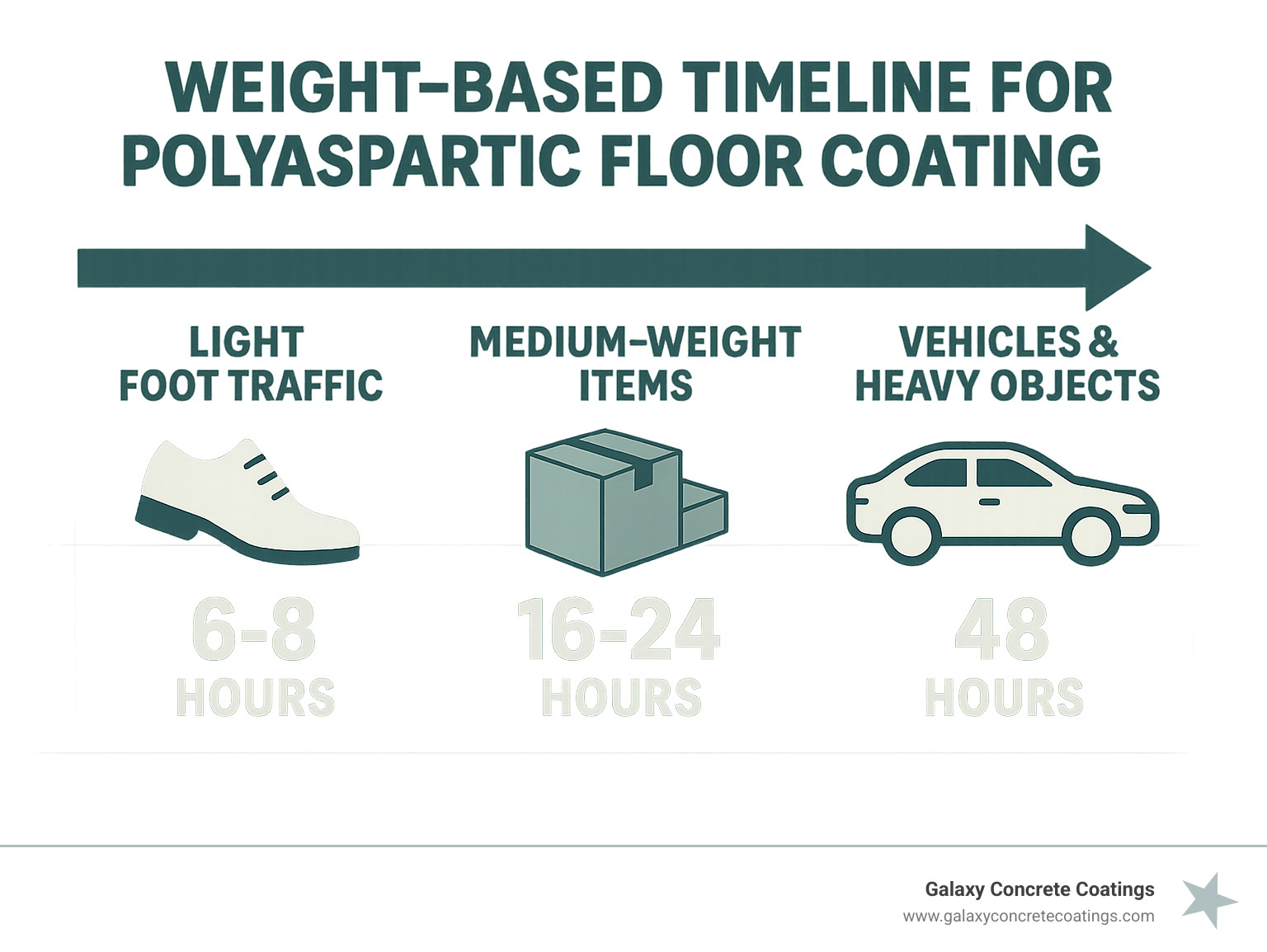
When temperatures drop below 55°F, expect to add about 2 hours before light foot traffic (so 6-8 hours total), and extend the timeline for medium items to 16-24 hours. Vehicles and heavy objects should wait a full 48 hours in cold conditions.
High humidity (above 75%) requires similar patience – add an extra 2-4 hours to each stage of the curing process.
“What amazes our customers most is that even in freezing temperatures, our polyaspartic coatings still cure properly,” notes Josh from our installation team. “We’ve successfully installed and cured floors at temperatures approaching -30°F – something that would be absolutely impossible with epoxy.”
Before every installation, we conduct thorough moisture testing of your concrete slab. High moisture emission rates can affect both adhesion and cure time, sometimes requiring the addition of a moisture barrier. This attention to detail is why Galaxy floors last for decades while others fail within years.
Heavy Objects, Furniture & Parking—Staged Return to Service
Think of returning your space to full use as a progressive journey rather than a single moment:
After approximately 12 hours, you can begin moving medium-weight objects like boxes, lightweight furniture, and storage items back onto your floor. The golden rule? Lift and place – never drag anything across a curing floor.
Wait at least 24 hours before placing heavy furniture, appliances, or tool chests on your new coating. This gives the polymers time to develop their incredible strength.
For vehicles, you can typically park on the floor after 24 hours in ideal conditions (70°F+). If your garage is cooler, giving it 48 hours provides an extra margin of safety that’s well worth the wait. Industrial equipment like forklifts should always wait the full 48 hours, regardless of temperature.
Hot tires deserve special consideration. When you’ve just driven home and your tires are warm, let them cool for at least 30 minutes before parking on a newly coated floor. Consider using tire mats for the first week, and avoid turning your wheels while stationary for the first 72 hours.
“One of my clients was so excited about his new floor that he parked on it exactly at the 24-hour mark,” recalls Hayley, our Galaxy manager. “Five years later, that floor still looks perfect – that’s the reliability of properly cured polyaspartic.”
Testing for Full Cure: Thumbprint & Gloss Checks
Not sure if your floor is ready? Try these simple tests that our pros use:
The Thumb Test is wonderfully straightforward – press your thumb firmly against the coating in a corner or hidden area. If it leaves no mark or indentation, your coating has reached sufficient hardness for normal use.
For the Knuckle Test, gently tap the surface with your knuckle. A fully cured coating produces a hard, solid sound rather than a dull thud.
A Gloss Check is equally telling – a fully cured polyaspartic coating displays consistent gloss across the entire surface. Any dull or tacky areas indicate incomplete curing.
While your floor may be ready for normal use after 24-48 hours, complete chemical curing continues for 5-7 days at temperatures of 77°F or warmer. During this time, the coating continues hardening and developing its maximum resistance to chemicals and abrasion.
For spaces that will encounter harsh chemicals or industrial conditions, we recommend waiting the full 7 days before exposing the coating to solvents or extreme conditions.
Post-Install Care: Cleaning, Mats & Maintenance
Once your polyaspartic floor coating has fully cured, keeping it looking stellar for years is surprisingly simple.
For cleaning, stick with pH-neutral cleaners like Simple Green® floor care diluted with water. Avoid harsh chemicals, citrus-based cleaners, and anything abrasive. For stubborn stains, a small amount of acetone can work wonders – just be sure to ventilate well for 2-3 hours afterward.
Preventative care makes a world of difference. Sweep regularly to remove grit that can scratch the surface, use felt pads under furniture legs, place mats at entrances to catch dirt, and in winter, clean up salt and de-icing chemicals promptly.
“My favorite customer comment came from a gentleman in Denver who said he cleaned his Galaxy floor with just a garden hose once a month,” shares our customer service team. “Three years later, it still looks brand new.” This minimal maintenance requirement is yet another stellar advantage of our polyaspartic coatings.
For more detailed care information, check out our complete guide on Galaxy Polyaspartic Concrete Coating.
Conclusion
So, how long before you can walk on polyaspartic floor coating? With Galaxy Concrete Coatings, you’re looking at a truly stellar 4-6 hours for light foot traffic and just 24 hours for full use in normal conditions. That’s light-years ahead of traditional epoxy, which keeps your life on hold for days on end.
This rocket-fast return to your normal routine isn’t just convenient—it’s for busy homeowners and businesses who can’t afford downtime. Our one-day installation process means minimal disruption to your family’s orbit, letting you get back to what matters most.
“The speed was incredible,” reports Colorado homeowner Jennifer M. “We had our garage floor coated in the morning and were able to walk on it that evening. By the next day, we had our cars back inside. It was like the installation barely happened!”
What makes our polyaspartic coatings truly cosmic isn’t just the speed—it’s the best durability, resistance to UV rays, and ability to withstand harsh chemicals that would damage lesser coatings. And unlike epoxy that yellows over time, our polyaspartic maintains its stellar appearance for decades.
With proper care using the simple maintenance tips we’ve shared, your Galaxy floor will maintain its showroom shine with minimal effort. Most of our customers report needing nothing more than occasional sweeping and light mopping to keep their floors looking like they were installed yesterday.
Peace of mind comes standard with every Galaxy installation thanks to our lifetime warranty. We stand behind our work because we know our advanced polyaspartic technology creates floors that truly stand the test of time—and foot traffic!
Whether your concrete needs a cosmic makeover in the mountain majesty of Denver, Colorado (https://maps.app.goo.gl/Puexf5x3GtjvLUmS6), the sun-soaked landscapes of Phoenix, Arizona (https://maps.app.goo.gl/upq42kxRjiuyPgRV8) or Tucson, Arizona (https://maps.app.goo.gl/HCnsQJdchAAsKuHQ7), or the heartland comfort of Cincinnati, Ohio (https://maps.app.goo.gl/uTQD7CL9nRtSDNTV6) or Indianapolis, Indiana (https://maps.app.goo.gl/o4jBAcVuGkrFhbBD9), our team of floor coating astronauts is ready to launch your concrete into the stratosphere.
Why stay grounded with yesterday’s epoxy technology when you can reach for the stars with Galaxy? Our five-star reviews shine brighter than Sirius, and our customer satisfaction ratings are truly out of this world. Ready for your concrete surfaces to make the quantum leap from ordinary to extraordinary? Contact us today for your free estimate and prepare for liftoff—we’re taking your concrete out of this world!